
ARTWORK PRICING CALCULATOR
.jpeg&output=webp&w=450&maxage=31d&q=75)
A Calculated Guide to Pricing Your Art
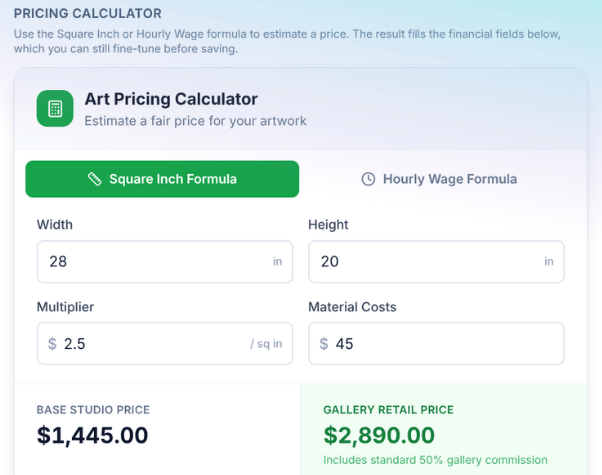
[PRICING_CALCULATOR]When you're starting out, pricing your own artwork is notoriously uncomfortable. It's incredibly easy to tie your personal self-worth to the price tag on the canvas, leading to second-guessing, underpricing, and burnout.To build a sustainable art practice, you must remove emotion from the equation. Pricing is not a reflection of your soul; it is a strict, objective business calculation. Whether you are selling out of your studio, setting up a booth at a local festival, or negotiating with a gallery, here is the professional framework for pricing your art.Step 1: Establish Your Baseline PriceBefore you can sell anywhere, you need an objective formula to determine what a piece is worth based on size, time, and materials. Pick the formula that best fits your medium.Method A: The Square Inch FormulaThis is the industry standard for 2D artists (painters, illustrators, printmakers). It guarantees your prices scale logically by size, so buyers can easily understand why a 16x20 costs more than an 8x10.The Formula: (Width × Length × Multiplier) + Cost of Materials = PriceThe Multiplier: If you are an emerging artist, start with a multiplier of $1.00 to $1.50 per square inch. Mid-career artists often use $2.50 to $5.00+.Example: For a 10x10 inch acrylic painting at a $1.50 multiplier, with $30 in canvas and paint costs: (10 × 10 = 100 sq inches) × $1.50 = $150 + $30 = $180.Method B: The Hourly Wage FormulaThis method is essential for highly detailed, time-intensive mediums (like hyperrealism, pointillism, or sculpture) where the physical footprint of the piece does not reflect the massive amount of labor involved.The Formula: (Hours Worked × Hourly Wage) + Cost of Materials = PriceThe Wage: Pay yourself a living wage. Never drop below your local minimum wage, and aim for $20 to $30+ per hour as a starting professional.Example: A detailed colored pencil drawing that took 15 hours at $25/hour, with $50 in premium paper and framing: (15 × $25 = $375) + $50 = $425.Step 2: The Golden Rule of Retail PricingOnce you have calculated your baseline price, you have established your Retail Price.The absolute golden rule of the art business is consistency. A specific painting must cost the exact same amount whether a collector buys it directly from your website, at a weekend art fair, or through a high-end gallery.Here is how to navigate the three main selling environments while protecting your Retail Price.1. Selling in GalleriesGalleries do the heavy lifting of marketing, hosting, and connecting you with high-net-worth collectors. Because of this, the standard gallery commission is a 50/50 split.The Strategy: Your baseline formula price must represent your take-home pay. If your formula dictates you need $500 to cover your time and materials, the official Retail Price on the gallery wall must be $1,000.2. Selling Privately (Your Studio or Website)When you sell directly to a collector via Instagram or your ArtHero portfolio, you keep 100% of the money.The Strategy: You must still charge the full $1,000 Retail Price. Never discount the work just because there is no gallery middleman. If a gallery finds out you are selling equivalent work out of your studio for half the price they are asking, they will drop you immediately for undercutting them. When selling privately, you simply get to pocket the gallery's 50% margin as a well-earned bonus for doing the marketing work yourself.3. Selling at Art Shows and FairsArt fairs require significant upfront investments, including booth fees, travel, display walls, and your weekend time. The audience here is also much broader than a curated gallery.The Strategy: Your original pieces remain at their strict Retail Price. However, selling at art shows can require a tiered pricing structure to capture impulse buyers who love your style but cannot afford an original. Always stock your booth with "bread and butter" items:Top Tier: Original framed pieces ($500 - $2,000+)Mid Tier: Limited edition, signed, and matted prints ($50 - $150)Low Tier: Small open-edition prints, sticker packs, or greeting cards ($5 - $25)The TakeawayThe hardest part of pricing is sticking to your guns when a buyer asks for a discount. By relying on a mathematical formula, you can confidently explain your pricing structure to anyone who asks. You aren't guessing your worth—you are running a business. Set your formulas, standardize your retail prices, and get back to the studio!