

PALETTE & PAINTING KNIVES
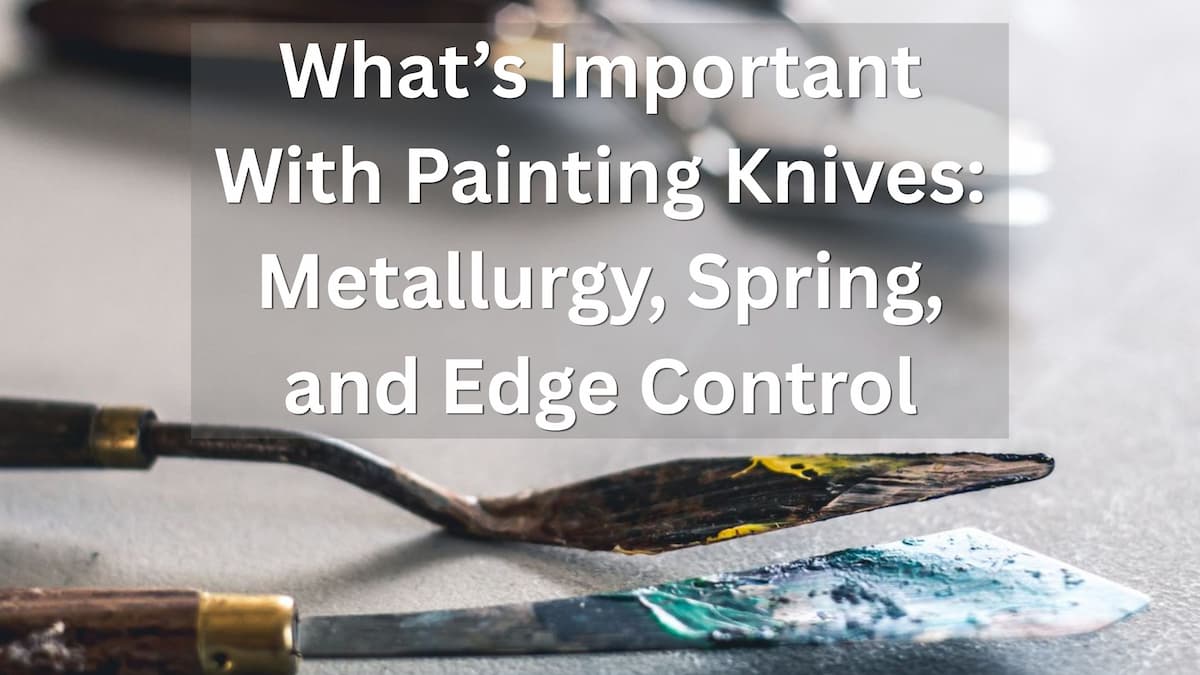
The Physics of the Painting Knife
For the technical painter, understanding the geometry and metallurgy of these tools is critical for achieving clean impasto, sharp architectural edges, and precise color mixing. While brushes manipulate paint by dragging it through thousands of individual fibers, knives apply paint as a structural solid. Using a knife allows for the application of thick paint without the textural interference of bristles or the need for solvent dilution.
The terms are often used interchangeably by beginners, but structurally, they are two completely distinct tools designed for different physics.
The Palette Knife: Characterized by a completely flat, straight blade extending directly from the handle. It is engineered exclusively for mixing heavy pigments on a glass or wood palette, scraping surfaces clean, and cutting through dense mediums. 🚨 The Warning: If you attempt to paint on a canvas with it, your knuckles will drag right through your wet artwork.
The Painting Knife: Characterized by a "cranked" or offset neck. This distinct bend acts as a physical bridge, dropping the blade down to the canvas while keeping your hand and knuckles safely elevated above the wet surface.
The performance of a knife is dictated by its flexibility and its "memory" (how quickly it snaps back to a flat zero-state after being bent against the canvas).
Forged Carbon Steel: The absolute professional standard. These blades are forged from a single piece of steel and tapered toward the tip. They offer maximum flexibility and an immediate "snap," allowing for highly responsive, pressure-sensitive application. (Note: They require diligent maintenance, such as oiling, to prevent rust).
Stainless Steel: The modern alternative. They are highly resistant to oxidation and harsh solvents, making them much easier to maintain, though they often lack the extreme, delicate flex of pure carbon steel.
Plastic / Polymer: Disposable tools. They completely lack tensile memory, snap easily under pressure, and have thick, blunt edges that simply cannot cut a sharp line or lay down a microscopic glaze of color. Avoid these for serious work.
The physical shape of the blade determines the exact footprint of the paint applied to the canvas.
The Diamond (Trowel): The versatile workhorse. The wide belly holds a massive reservoir of paint for broad strokes, the straight edges can scrape away mistakes or cut architectural lines, and the extremely sharp point can drop microscopic highlights onto an eye or a water droplet.
The Teardrop (Rounded): Because it has absolutely no sharp corners, this blade is specifically engineered for soft blending. It allows the artist to press heavy paint into a wet underlayer without the corners gouging or scratching the paint beneath it. It is ideal for clouds, skin tones, and organic forms.
The Long Flat: A highly specialized blade featuring a long, rectangular edge. It is used to pull long, unbroken ribbons of paint across a surface. This is absolutely essential for painting distant horizons, sharp ocean lines, or rigid mechanical structures.

Blick Palette Knives
Blick Art Materials (Dick Blick) is the largest art retailer in the United States. Usually, "store brand" art supplies are mediocre knock-offs of the real thing.Blick is the exception. Their line of painting knives is one of the best-kept secrets in the budget art world. While they are priced significantly lower than premium brands, they are often manufactured in the exact same region of Italy as top brands. If you want professional performance but need to save $3 per knife, this is your stop.The "Made in Italy" secretIf you look closely at the blade of a Blick Studio painting knife, you will often see the stamp "Made in Italy."The Reality: It is widely known in the industry that Blick contracts many of their knives from RGM (the gold standard manufacturer mentioned in our RGM report).The Hack: You are essentially buying a high-end Italian knife with a different logo stamped on the handle. The steel quality, grind, and spring are nearly identical to the name-brand version, but the price is stripped of the marketing markup.The product linesBlick Studio (Wooden handle)The Look: Classic dark wood handle with a blued steel or bright steel blade.The Feel: These have excellent "spring." Unlike the stiff Amazon brands like Conda, these blades snap back to straightness instantly. They feature a solid brass ferrule that keeps the blade from wobbling—a common failure point in cheaper knives.Blick Comfort Grip (Blue handle)The Look: A distinct blue, rubberized handle.The Use: This is their answer to the Liquitex "Freestyle" line. The handle is ergonomic and non-slip, making it perfect for acrylic painters whose hands get slippery with water and medium.The Blade: Stainless steel (rust-resistant). Slightly stiffer than the wood-handle carbon versions, but bomb-proof in durability.Working propertiesFlexibilityBecause these are Italian-made, they possess the critical "taper grind." The blade is thicker near the handle for strength and thinner at the tip for sensitivity. This allows you to apply delicate glazes or scratch aggressively without changing tools.The "Crank"The Z-bend in the handle is deep and properly angled. You can lay the blade completely flat against the canvas without your knuckles dragging in the wet paint—a flaw found in almost every other "budget" brand.ConsistencyThe biggest advantage of buying Blick over a random Amazon brand is quality control. Every knife is inspected. You won't receive a blade with a burr on the edge or a loose handle. If you do, their return policy is legendary.The ArtHero VerdictBuy Blick Studio if:You are value-hunting: You want RGM quality but are filling a classroom list or buying in bulk.You want the "safe bet": You don't want to gamble on Amazon roulette. You know exactly what you are getting every time.Skip them if:You want the "style" shapes: While Blick has a good range, RGM's own branded line still offers a wider variety of weird, experimental texture shapes ("New Age" line).Best starter tool:The Blick Studio Painting Knife - Style 9. It is the classic diamond trowel shape, perfectly balanced, and costs less than a latte.

Conda Palette Knives
Conda is a massive Chinese art supply manufacturer that dominates the "budget/student" market on Amazon and global marketplaces. If you search for "painting knife set" and sort by "Price: Low to High," you're looking at Conda.The verdict up front:They are serviceable but inconsistent.Buy them if: You are a beginner who wants to experiment with texture for the first time and don't want to spend $8 on a single knife.Avoid them if: You are serious about "spring" and control. The steel is softer and less responsive than Italian brands like RGM.The material qualityThe metal (Stainless steel?)Conda knives are labeled stainless steel, but they are significantly stiffer than professional knives.The Problem: Good steel "snaps" back instantly like a spring. Conda steel tends to be rigid. You have to press harder to get the blade to bend against the canvas.The Risk: Because they are stiffer, it is harder to do delicate "skimming" techniques (gliding paint over the surface). You are more likely to accidentally scrape the paint off rather than lay it down.The handles (A weak point)This is the most common failure point.Construction: The metal blade is inserted into a wooden handle and held by a metal collar (ferrule).Issue: In budget brands like Conda, the glue inside the handle often fails. After a few months of washing, the blade might start to wiggle or fall out completely.The Fix: If it wobbles, pull it out, put a drop of Gorilla Glue / Super Glue in the hole, and jam it back in. It will be stronger than new.The "Set" trapConda almost exclusively sells 5-piece or 10-piece sets for roughly $10–$15.The Good: You get a lot of shapes for the price of one professional knife.The Bad: You will likely use Knife #1 (The Diamond) and Knife #4 (The Long Spatula) and never touch the other three. The "weird" shapes (tiny fans, jagged edges) are often useless fillers included to make the set look valuable.Working propertiesEdge sharpnessItalian knives (RGM) have flexible, thin edges. Conda knives often have thicker, blunter edges.Impact: You cannot get a razor-sharp "hard edge" line as easily. They are better for mixing paint or applying thick impasto blobs than for precise architectural lines.DurabilityThey are generally rust-resistant (a plus for acrylic painters who leave them wet). However, do not leave them soaking in water, or the wooden handles will swell and crack.The ArtHero VerdictBuy Conda if:You are mixing paint: Use them as palette knives to save your expensive brushes.You use heavy mediums: If you are scooping modeling paste or heavy gel out of a jar, you don't need a sensitive Italian blade. You need a shovel. Conda is a great shovel.You are a teacher: If you are buying for a classroom where tools get lost or abused, the price point is unbeatable.The upgrade path:Start with a Conda set to learn the hand motions. Once you find the one shape you love (often a diamond trowel), go buy the RGM or Holbein version of that specific shape. You will instantly feel the difference in the flexibility.

Liquitex Knives
Liquitex is the brand that invented acrylic paint. Consequently, their tools are designed specifically with the acrylic artist in mind.While traditional brands like RGM focus on oil painters (carbon steel, wooden handles), Liquitex focuses on the modern, water-based painter. Their flagship line, "Freestyle," is famous for two things: ergonomic non-slip handles and massive, oversized blades for large-scale abstract work.The Product LinesThe "Basics" LineLike their paint, Liquitex offers a "Basics" line of tools. You will often see these in blister packs of 5 or 6.Material: Usually molded white plastic/nylon.Verdict: Avoid. As stated in the Introduction To Palette Knives, plastic knives have no "spring." They push paint clumsily and dull quickly. They are fine for children, but an adult artist will find them frustrating.The "Freestyle" Line (The Professional Choice)This is the line you want. It is divided into two sub-categories:Traditional: Standard sizes but with the unique Liquitex handle.Large Scale: Huge, shovel-sized tools for covering massive canvases.The "Freestyle" difference: Why choose them?The rust-free promiseThe problem: Traditional Italian knives (RGM) are often made of carbon steel. They have amazing flexibility, but if you leave them wet (which happens often with acrylics), they will rust.The Liquitex solution: These blades are high-grade stainless steel. They are virtually impervious to rust. You can leave them in a water bucket by accident, and they will likely survive. This makes them the top choice for messy acrylic painters.The handleUnlike the classic wooden handles of Holbein or RGM, Liquitex uses a contoured, rubberized grip.Pros: They are non-slip. If your hands are covered in gel medium or water, these handles won't slide around. They feel substantial and ergonomic.Cons: They lack the "warmth" and tactile feedback of wood. Some purists find that they feel too "industrial."The "Large Scale" innovationThis is where Liquitex has no competition. They manufacture massive painting knives—some are as big as a trowel or a spatula you’d see in a commercial kitchen.Use case: If you're an abstract artist working on canvases larger than 3 feet, a tiny standard knife is useless. The Liquitex Large Scale knives allow you to sweep a single layer of color across 12 inches of canvas in one motion.Technique: They are perfect for "squeegee" techniques (dragging paint thinly) similar to the style of Gerhard Richter.Working propertiesFlexibility vs. stiffnessStiffness: Liquitex blades tend to be slightly stiffer than RGM blades.Why: Acrylic heavy body paint is often thicker and stickier than oil paint. The stiffer blade helps push this heavy goo around without the knife buckling.Trade-off: They are less suited for delicate, whisper-thin details. They are tools for boldness.DurabilityThese are built like tanks. The blade is securely attached to the synthetic handle. Unlike cheap wooden handles that swell and crack when wet, the Liquitex handle is waterproof.The ArtHero VerdictBuy Liquitex Freestyle if:You paint with acrylics: The rust resistance is a huge quality-of-life improvement.You paint BIG: If you work on canvases larger than 24x36", their "Large Scale" series is essential.You hate loose handles: The synthetic construction is bomb-proof.Stick to RGM / Holbein if:You paint with oils: You don't need the rust protection, and you will likely prefer the delicate spring of carbon steel.You do fine detail: The Liquitex blades are a bit too "chunky" for detailed precision work.Best starter tool:The Liquitex Freestyle Small Painting Knife #1 (Diamond shape). It gives you the durability of the brand in a standard, usable size.

RGM Painting Knives
RGM (Rosa, Gimona, & Maniago) is the benchmark against which all other painting knives are measured. Manufactured in Maniago, Italy—a town famous for centuries of sword and knife making—RGM produces the tools found in the studios of almost every professional oil painter.If Liquitex is the modern, industrial choice for acrylics, RGM is the purist's choice for oils and heavy body paint. They offer the perfect balance of price (affordable) and performance (elite).The critical distinction: Carbon steel vs. stainless steelMost cheap brands use generic stainless steel. RGM offers both, but they are famous for their Carbon Steel line. You must know the difference before you buy.The "Classic" Line (Carbon steel)The Look: Dark grey, gunmetal blade with a wooden handle.The Superpower: Flexibility. Carbon steel can be ground thinner than stainless steel while retaining its strength. This gives RGM knives their legendary "spring." You can bend the blade 90 degrees against the canvas, and it will snap back instantly to perfect straightness.The Trade-off: Rust. If you leave these wet, they will rust overnight. You must dry them immediately after washing.The "Plus" Line (Stainless steel)The Look: Shiny, mirror-polished silver blade.The Use: Designed for acrylic painters who use water and corrosive mediums. They will not rust.The Feel: Slightly stiffer than the carbon version, but still miles ahead of budget brands like Conda.The build qualityThe grindCheap knives are stamped out of a sheet of metal and have consistent thickness. RGM blades are taper-ground.What this means: The blade is thick near the handle (for strength) and paper-thin at the tip (for flexibility). This tapering allows for incredibly sensitive paint application—you can whisper the paint onto the surface or scrape it off aggressively with the same tool.The handleClassic: Bubinga or olive wood. Feels warm and tactile.Soft Grip: RGM's answer to Liquitex. A black rubberized handle for artists who hate the feel of wood or work with messy fluids.The "New Age" collectionRGM is the only brand that successfully innovated beyond the standard diamond shape. Their "New Age" line features bizarre, jagged, and multi-shaped knives.What they are for: These are texture generators. Some look like combs, others like forks. They are excellent for Sgraffito (scratching into wet paint) to create instant grass, hair, or architectural textures.Working propertiesThe "step"The Z-bend (crank) on an RGM knife is deep and structural.Why it matters: Cheap knives often have a shallow bend. When you try to lay the blade flat, your knuckles accidentally drag through the wet paint. RGM’s deep crank keeps your hand safely elevated high above the canvas.Edge precisionThe edges are not sharp enough to cut you, but they are sharp enough to scrape a canvas down to the white gesso. This makes them the ultimate tool for correction. If you mess up a passage in an oil painting, one swipe of an RGM knife removes the mistake cleanly.The Arthero VerdictBuy RGM (Classic carbon steel) if:You paint in oils: The "spring" of carbon steel is unmatched. It feels like an extension of your finger.You are disciplined: You don't mind the 5-second ritual of drying your tools to prevent rust.You want the best: At roughly $6–$8 USD, they are barely more expensive than the junk brands, but they perform 10x better.Buy RGM (Stainless steel/Plus) if:You paint in acrylics: You want the Italian craftsmanship but don't want to worry about rust ruining your tools.Best starter tool:The RGM Classic Series #45 or #50. This is the quintessential diamond trowel shape that belongs in every artist's kit.