TECHNICAL PENCILS
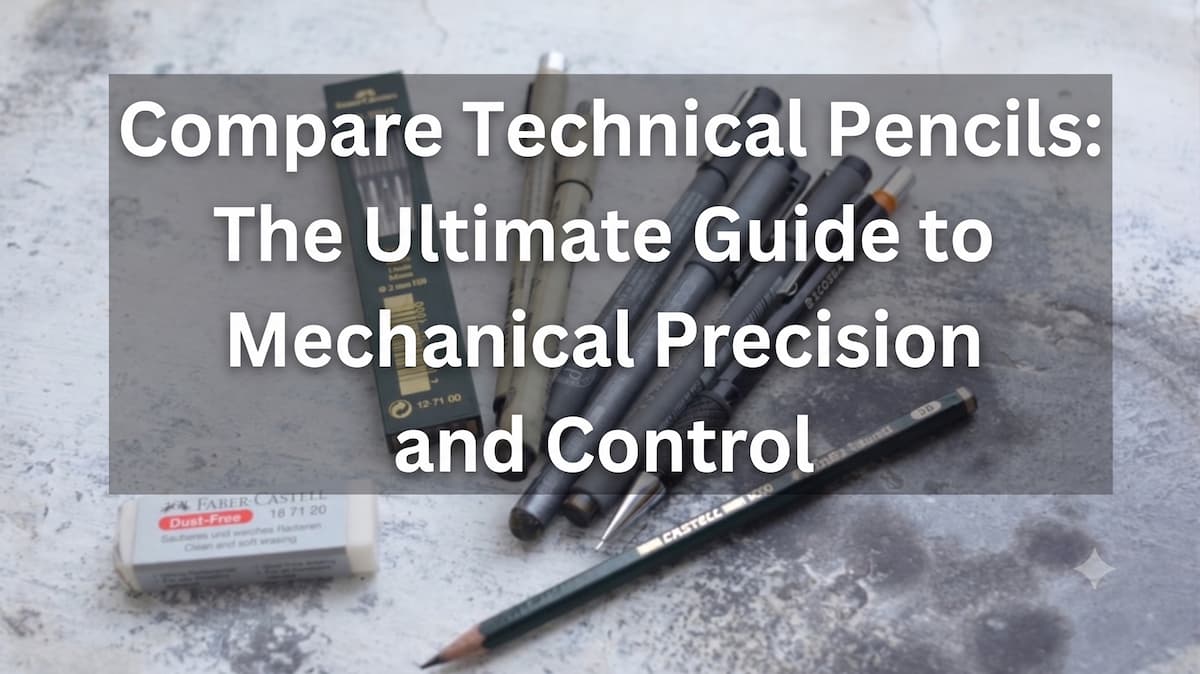
The standard yellow #2 school pencil is the enemy of precision. As you draw with a traditional wood pencil, the tip dulls immediately—meaning your line starts thin and ends thick, and you spend far too much of your time sharpening.
The Solution: Technical (or mechanical) pencils. They maintain a constant, perfect line width forever, they never get shorter as you use them, and they are engineered to balance perfectly in the hand.
The defining feature of a technical pencil is the lead sleeve—the tiny metal pipe at the tip that protects the graphite.
Drafting Pencils: Feature a long (approx. 4mm) fixed sleeve. This allows you to run the pencil along a thick ruler or template without the wood hitting the edge. It gives you 100% visibility of exactly where the lead touches the paper. (The Danger: If you put a fixed-sleeve pencil in your pocket, it will stab your leg or bend the tip, ruining the pencil).
Writing Pencils: Feature a short, often conical sleeve designed strictly for general writing, not template work or drafting.
Mechanical Pencils (0.3mm to 0.9mm): Uses ultra-thin lead sticks pushed through an internal mechanism for maximum precision. Because the lead is so thin, you never have to sharpen it. The 0.5mm is the industry standard for most artists. For microscopic details, use 0.3mm (though it snaps easily). For heavy-handed sketchers, use 0.7mm or 0.9mm to prevent breakage.
The Lead Holder (The "Clutch" Pencil): A mechanical casing that holds a thick 2.0mm lead (the exact same thickness as a traditional wood pencil core). It uses internal "jaws" (a clutch) to grab the lead. When you press the button, the lead drops out via gravity. It combines the expressive shading capabilities of a wood pencil with the permanent balance of a mechanical tool. (The Secret: The push-button cap almost always has a built-in sharpener/pointer inside it to sharpen the 2mm lead).
Technical pencils allow you to swap lead grades instantly, often tracked by a built-in indicator dial on the pencil body.
H Grades (2H, 4H): Contains a hard clay content. They produce light, grey lines that do not smudge. Use these for initial construction lines that you plan to ink over later.
HB: The middle ground. This is the standard lead found inside almost all mechanical pencils sold in stores.
B Grades (2B, 4B): Contains a soft graphite content. They produce dark, rich black lines but smudge easily. Use these for heavy shading and finishing. (Note: You usually must specifically order 2B or 4H leads online, as craft stores rarely stock them).
The "Standard" (Pentel GraphGear 1000): The killer feature here is the retractable tip. When you clip it to your pocket, the entire metal tip sucks inside the heavy metal body. No stabbed legs, no bent tips. It is the most practical, durable all-rounder for students and traveling artists. (Note: The Pentel P205 is their classic black plastic pencil—cheap and reliable, but very lightweight).
The Top Tier (Rotring 600): The absolute status symbol for architects and designers. Featuring a hexagonal brass body and an aggressive, non-slip knurled grip, it feels like a heavy, cold surgical instrument. (The Flaw: The tip is fixed. If you drop it tip-down, the metal sleeve bends, and the pencil is permanently ruined).
The "Innovation" (Uni Kuru Toga): With normal pencils, the lead wears down on one side, creating a "chisel" tip that makes your line wider. The Kuru Toga fixes this with an internal engine that micro-rotates the lead every time you lift the pencil from the page. It automatically keeps the tip perfectly conical and sharp.
The "Clutch" Classic (Staedtler Mars Technico 780): The iconic blue 2mm lead holder. It is virtually indestructible and perfect for artists who want to sketch loosely without constantly whittling down wood pencils.
The Everyday Carry: Try the Pentel GraphGear 1000 (0.5mm). The retractable tip saves the pencil (and your pants), while offering professional weight and balance for roughly $10.
The Desk King: Try the Rotring 600 (0.5mm). If it lives safely on your desk and won't be dropped, it is the most satisfying drawing tool ever made. The heavy brass weight physically forces you to slow down and be precise.
The Sketcher: Try the Staedtler Mars Technico (2mm lead holder) paired with a pack of 2B Leads. It allows for the bold, expressive shading that thin mechanical pencils simply cannot do. It is essentially a wood pencil that never gets short.

Blick Brand Mechanical Pencils
Blick Art Materials has leveraged its massive retail presence to manufacture a line of house-brand pencils that directly clone the features of premium Japanese drafting tools at a fraction of the cost. They don't just put their logo on generic plastic pencils; they target specific "pain points" of the Rotring and Pentel lines (like fragility or price) and engineer their own solutions.1. Blick Premier Mechanical Pencil (The "Double Knock" Specialist)This is Blick’s "Flagship" pencil, designed to compete directly with the Rotring 800. Its defining feature is the Double Knock mechanism, a safety feature rarely seen in this price range.Retractable Safety: Unlike the Rotring 600, which has a fixed tip that bends easily, the Blick Premier uses a "Double Knock" system. A hard click extends the steel tip; a soft click extends the lead. When you are done, a hard click retracts the entire tip back into the body, making it completely pocket-safe and drop-resistant.Full Aluminum Body: It features a lightweight but rigid aluminum body with a matte silver finish, distinguishing it from the heavy brass of Rotring. This makes it less fatiguing for long drawing sessions.Lead Cushioning: It includes an internal spring suspension for the lead. If you press down too hard while drawing, the lead slides back slightly into the sleeve rather than snapping.2. Blick Studio Mechanical Pencil (The GraphGear Rival)This model is clearly engineered to compete with the Pentel GraphGear 500, widely considered the best value in drafting.Metal Grip / Plastic Body: It uses the same weight-distribution strategy as the Pentel GraphGear 500 and Rotring 500: a heavy, knurled metal grip paired with a lightweight plastic barrel. This pushes the center of gravity forward, naturally guiding the tip into the paper.4mm Fixed Sleeve: It features the industry-standard 4mm rigid tube for precise ruler work.Chrome Knurling: A distinct aesthetic choice is the chrome-plated grip. It is shinier and slightly smoother than the matte grit of a Rotring, which some artists find less abrasive on the skin during long sessions.3. Blick Essentials Mechanical Pencil (The Student Standard)This is the "classroom" pencil, designed to replace the disposable Bic mechanical pencils with a durable, refillable tool.ISO Color Coding: The barrels are color-coded to match the international ISO standard (Green for 0.3mm, Black for 0.5mm, Blue for 0.7mm), allowing you to grab the right line weight instantly from a pile.Brass Clutch: Despite being a budget pencil, it uses a brass internal clutch mechanism rather than plastic, ensuring the lead advances consistently and doesn't slip back in while writing.Technical SummaryBuy the Blick Premier if you want the Retractable Tip safety of a Rotring 800 but don't want to spend $50.Buy the Blick Studio if you want the Forward Balance of a metal grip for precision drafting.Buy the Blick Essentials for reliable, color-coded field work where losing a pencil isn't a tragedy.

Pentel Technical Pencils
Pentel (Tokyo, Japan) is technically distinguished by its focus on Mechanism Innovation. While other brands rely on heavy brass bodies (Rotring) or simple balance (Staedtler), Pentel aggressively engineers complex internal mechanisms to solve specific drafting problems—such as tip fragility and lead breakage—without sacrificing durability. They are widely considered the "workhorse" brand of the engineering world.1. GraphGear 1000 (The Field Standard)This is Pentel's flagship "Dual-Action" pencil, engineered specifically to solve the "bent tip" problem that plagues fixed-sleeve drafting pencils.Dual-Action Retractor: The defining feature is the spring-loaded clip. When you clip the pencil to your pocket, the entire tip assembly (sleeve and lead) snaps instantly inside the body. This makes it pocket-safe and drop-resistant, unlike traditional fixed-sleeve pencils.Hybrid Grip: The grip combines knurled metal with inlaid latex-free rubber pads. This technical choice offers the "bite" of metal for precision but the cushion of rubber to reduce finger fatigue during long sessions.Caliper Clip: It features a heavy-duty, spring-loaded hinged clip (resembling a caliper) that opens wide to clamp onto thick notebooks or denim without bending, a distinct upgrade from standard friction clips.2. Graph 1000 "For Pro" (The Studio Standard)Often confused with the GraphGear, the "For Pro" is a completely different tool. It is the hidden gem preferred by professional animators and architects who work at a desk for 8+ hours a day.Zero-Fatigue Weighting: It is engineered to be exceptionally light (approx. 11g) with a low center of gravity. Unlike heavy brass pencils that strain the wrist over time, this pencil disappears in the hand, allowing for rapid, fluid movement.Integrated Rubber/Metal Grip: The grip is a single unit where rubber fins protrude through a metal frame. This provides a non-slip surface that doesn't feel "squishy" or unstable, maintaining the rigid feedback required for technical drawing.Stepped 4mm Sleeve: It uses a fixed lead sleeve that is stepped down from the barrel, providing maximum visibility of the paper and ruler edge.3. GraphGear 500 (The Heavyweight Budget)The 500 is technically unique because it reverses the standard "cheap pencil" construction.Extreme Forward Balance: It features a heavy knurled metal grip attached to a lightweight plastic barrel. This pushes the center of gravity drastically toward the tip, forcing the pencil onto the paper.Mesh Grip: The grip knurling is rougher and more aggressive than the 1000 series, providing maximum traction for sweaty hands or field work.Value Proposition: It offers the same precise 4mm fixed sleeve performance as professional models but at a student price point, making it the standard issue for architecture students.4. P200 Series (The Industry Legend)The P205 (0.5mm) and P207 (0.7mm) are arguably the most famous mechanical pencils in history.12-Sided Bezel: The barrel features a dodecagonal (12-sided) shape that resists rolling but feels round in the fingers.Mechanism Durability: The internal clutch mechanism is legendary for its simplicity and refusal to jam. Many engineers still use the same P205 they bought in college 20 years ago.Needle Tip: The nose cone tapers dramatically to the sleeve, offering one of the narrowest sightlines of any pencil, which is critical for intricate detail work.5. Orenz Nero (The Technological Marvel)This is Pentel’s high-tech "halo" product, designed to allow writing with microscopic 0.2mm and 0.3mm leads without breaking them.Auto-Advancement: You only click once. As you write, the sleeve protects the lead; when you lift the pencil off the paper, a spring mechanism automatically extends the lead and sleeve back out. You can write an entire page without clicking.Sliding Sleeve Protection: The lead never actually protrudes past the steel pipe. You write with the pipe gliding on the paper (the edges are rounded to prevent scratching), making it mechanically impossible to snap the delicate lead.Resin-Metal Body: It uses a unique composite material that feels like a blend of ceramic and plastic, offering a dense, premium weight.Technical SummaryBuy the GraphGear 1000 if you work in the field and need a pocket-safe, retractable tool.Buy the Graph 1000 "For Pro" if you are an animator or architect drawing for 8 hours a day and need agility.Buy the GraphGear 500 if you want the best balance-to-price ratio on the market.Buy the Orenz Nero if you want to use ultra-fine 0.2mm lead without breakage.

rOtring Technical Pencils
rOtring (stylized "red ring"), founded in Hamburg, Germany in 1928, is technically distinguished as the "Gold Standard" of mechanical pencils. While other brands (like Pentel or Pilot) make excellent tools, rOtring is the only brand that is universally synonymous with "Drafting." Their reputation is built on Full-Metal Construction and Hexagonal Ergonomics, designed to prevent the tool from rolling off a slanted drafting table.1. rOtring 600 (The Icon)This is widely considered the single best mechanical pencil ever made for technical drawing. It is the "control group" against which all other drafting pencils are measured.Full Brass Body: The entire chassis is machined from solid brass, giving it a significant weight (approx. 22g). This weight forces the pencil into the paper, meaning the artist/drafter applies less downward pressure, reducing hand fatigue.Fixed Guidance Sleeve: It features a 4mm fixed lead sleeve. This long, rigid steel pipe creates a precise view of the paper (essential for ruler work) and has absolutely zero "wobble" or play.Knurled Grip: The metal grip features a diamond-cut knurling pattern that is aggressive enough to prevent slipping but refined enough not to cut the skin.Fragility Warning: Because the sleeve is fixed and the body is heavy, if you drop a Rotring 600 tip-down, the sleeve will bend, often rendering the pencil useless. It is a studio tool, not a pocket tool.2. rOtring 800 / 800+ (The Retractable Luxury)The 800 is the "Executive" version of the 600, engineered to solve the fragility issue."Twist and Click" Mechanism: The entire front section (sleeve and lead) retracts into the body with a twist of the knurled top ring. This makes the pencil pocket-safe and drop-resistant.Gold-Plated Clutch: It uses a high-precision brass clutch mechanism for consistent lead advancement.The "Wobble" Trade-off: Technical Note: Because the tip moves, there is a microscopic amount of "play" or wobble in the tip compared to the rock-solid fixed sleeve of the 600. Purists often prefer the 600 for this reason.The 800+ Variant: Identical to the 800, but the tip retracts into a silicone stylus, allowing the pencil to be used on touchscreens when not writing.3. rOtring Rapid Pro (The Modern Hybrid)Designed as a bridge between the precision of the 600 and the durability of a field tool.Sliding Sleeve: Unlike the 800's twist mechanism, the Rapid Pro uses a sliding sleeve. The sleeve retracts automatically as you write, allowing you to use a huge portion of the lead before clicking again.Cushion Mechanism: It features a spring-loaded clutch. If you press too hard, the lead slides back into the pencil slightly rather than snapping. This makes it the technical choice for heavy-handed writers.Plastic Joiner: Durability Note: While the body looks metal, the "red ring" section in the middle is plastic. This acts as a crumple zone to absorb shock if dropped, but it is a weak point that can snap under extreme torque.4. rOtring 500 (The Lightweight Specialist)The 500 is technically unique because it combines the metal grip of the 600 with a plastic body.Center of Gravity: Because the grip is heavy metal and the body is light plastic, the center of gravity is shifted extremely forward (towards the tip). Many illustrators prefer this balance over the 600 because it feels faster and more agile for rapid sketching.Cost Efficiency: It provides the exact same knurled grip experience as the 600 at half the price.Technical SummaryBuy the 600 if you want the absolute best drawing experience and work at a desk (Fixed Sleeve precision).Buy the 800 if you carry your pencil in a pocket (Retractable safety).Buy the Rapid Pro if you are heavy-handed (Cushion mechanism).Buy the 500 if you prefer a lighter, front-weighted tool for sketching.

Staedtler Technical Pencils
While Rotring is the heavyweight champion of "Engineering," Staedtler (Nuremberg, Germany) is the undisputed king of Architecture. Their philosophy differs fundamentally from Rotring: instead of maximizing weight (brass), Staedtler maximizes balance and agility (aluminum). Their "Mars" blue branding is the global ISO standard for drafting rooms, and they are the world's leading manufacturer of the Lead Holder (2mm) system, which many architects prefer over fine-line mechanical pencils.1. Staedtler 925-25 / 925-35 (The "Silver Series")This is the direct competitor to the Rotring 600. However, where the Rotring 600 is designed to be heavy and immovable, the Staedtler 925 is designed to be light and fatigue-free.Aluminum Construction: The body is milled from high-grade aluminum rather than brass. This makes it significantly lighter than the Rotring 600 (approx. 17g vs 22g). Architects often prefer this for long drafting sessions (4+ hours) where the heavy Rotring can cause hand cramping.The "25 vs 35" Myth: A common point of confusion. The 925-25 is the Silver model; the 925-35 is the "Midnight Blue" (or Black) model. Technically, they are identical. The difference is purely cosmetic, though the matte black "All-Black" 35 version is highly prized for reducing glare under bright studio lamps.Lead Grade Indicator: It features a rotatable ring in the grip to indicate which lead hardness is loaded (4H to 4B). Unlike competitors that use loose stickers or loose rings, the Staedtler mechanism is stiff and "clicks" into place, ensuring it never lies to you.2. Mars Technico 780 (The Lead Holder Standard)While Rotring dominates 0.5mm mechanical pencils, Staedtler owns the 2mm Lead Holder market. This tool doesn't push thin lead; it clutches a thick 2mm stick of graphite that mimics a wood-cased pencil.Clutch Mechanism: It uses a heavy-duty brass "jaw" mechanism. When you press the cap, the jaws open, allowing the lead to slide freely (gravity feed) rather than clicking out incrementally. This allows artists to extend the lead 3 inches for shading or retract it fully for travel.Integrated Pointer: The push-button cap pulls off and functions as a miniature lead sharpener. You insert the lead into the cap and twist to restore a needle point, meaning the sharpener is always built into the tool.The "Blue" Icon: The 780 is easily recognized by its classic blue plastic barrel and knurled metal grip. It is widely considered the most durable lead holder ever made; many from the 1970s are still in daily professional use.3. Mars Micro 775 (The Student Standard)If you took a drafting class in high school or college, this is likely the pencil you used. It is the "workhorse" of the system.Cylindrical Lead Sleeve: The lead sleeve locks into place but is designed to slide back if pressed with extreme force, protecting the lead from breaking.ISO Color Coding: The push buttons are color-coded to the ISO standard (Yellow for 0.3, Brown for 0.5, Blue for 0.7), allowing drafters to grab the correct line weight instantly without looking at the label.4. The 502 Lead Pointer Tub (The Ecosystem)No report on Staedtler is complete without the Mars 502. This is the rotary sharpener designed specifically for the Technico 780.Rotary Action: You insert the 2mm pencil into the hole and spin it around the rim. The tub contains a hardened steel milling cylinder that grinds the graphite into a lethal point.Graphite Dust Trap: It captures the conductive graphite dust (which is messy and bad for electronics) inside a sealed tub, keeping the drafting table clean.Technical SummaryBuy the 925-25/35 if you find the Rotring 600 too heavy or if you work for extended hours.Buy the Mars Technico 780 if you want the freedom of 2mm lead (shading, varying line widths) rather than the fixed width of a mechanical pencil.Buy the Mars Micro for reliable, color-coded field work.