
Introduction To Acrylic Brushes
Related Categories
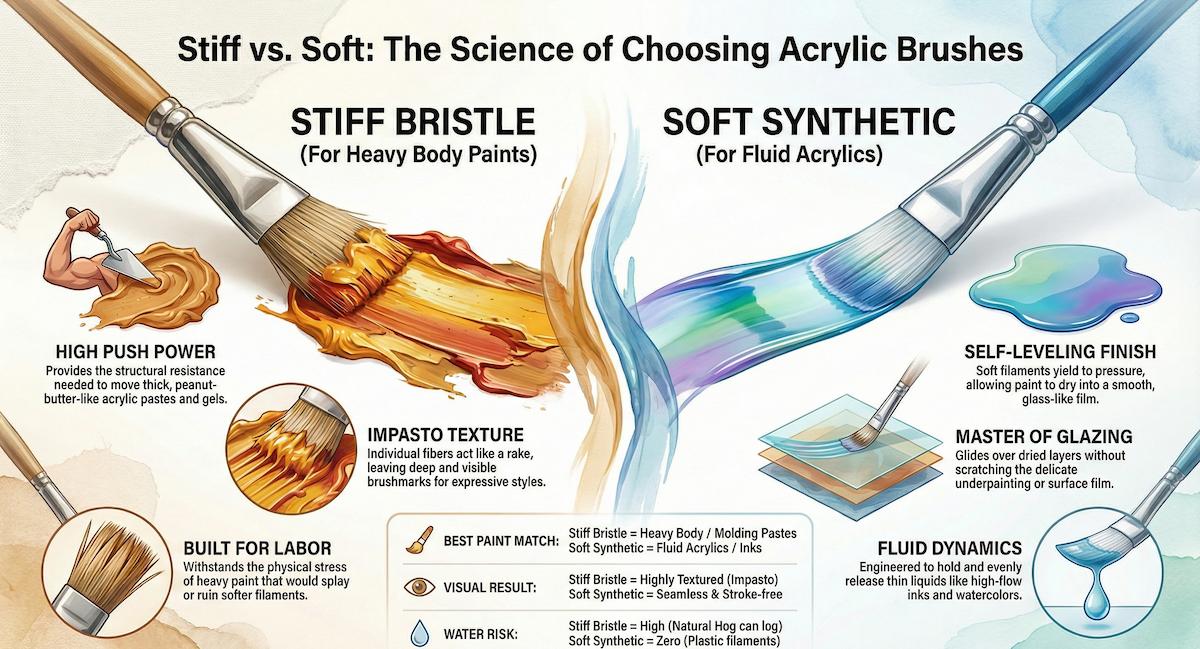
Because acrylics come in vastly different viscosities—from water-thin, high flow inks to thick, peanut-butter-like heavy body pastes —the choice of brush material is dictated entirely by the viscosity of the paint being used.
These brushes are built for structural integrity and resistance. While traditional natural hog bristle can be used, many modern artists prefer stiff synthetics (often white nylon) because natural bristles can become waterlogged and lose their "snap" when soaking in water-based acrylic mediums.
Performance Characteristics
Push Power: They have immense structural resistance. They will not bend or yield when digging into thick, unthinned heavy body acrylics or modeling pastes.
Texture Retention: The stiff individual fibers act like a rake. They leave deep, distinct, and highly visible brushmarks (impasto) in the paint film, which is perfect for expressive, painterly techniques.
Durability: Heavy body acrylics are heavy and dense; pushing them around will quickly and permanently bend or snap the delicate filaments of a soft brush. Stiff bristles withstand the physical labor of impasto painting.
Drawbacks: They are not good for fluid acrylics or glazing. The stiff bristles will scrape away thin layers of wet paint rather than laying them down smoothly.
These are extruded plastic filaments engineered to be smooth, flexible, and gentle. They mimic the behavior of natural sable or mongoose but are chemically resistant to the alkalinity of acrylic polymer.
Performance Characteristics
Self-Leveling & Smoothness: Because the filaments are soft and yield instantly to pressure, they leave almost zero brushstrokes behind. They allow fluid acrylics to self-level into a smooth, glass-like plastic film.
Fluid Dynamics: They are the mandatory choice for fluid acrylics, high flow acrylics, and acrylic inks. They hold thin liquids well and release them evenly.
Glazing: When applying thin, transparent layers of acrylic medium (glazes) over a dried underpainting, soft synthetics glide over the surface without scratching the delicate underlying film.
Drawbacks: They lack the muscle to move heavy body paints. Attempting to use a soft synthetic with thick acrylic paste will cause the bristles to instantly splay, ruining the brush and resulting in clumsy, uncontrollable marks.
Choose stiff bristle if:
You paint with heavy body acrylics right out of the tube, use thickening gels or molding pastes, want highly textured, visible brushstrokes, or paint aggressively on rough canvas.
Choose soft synthetics if:
You thin your acrylics with water or glazing liquid, use fluid/high flow paints, paint hyper-realistic portraits requiring seamless blending, or want a perfectly smooth, stroke-free finish.
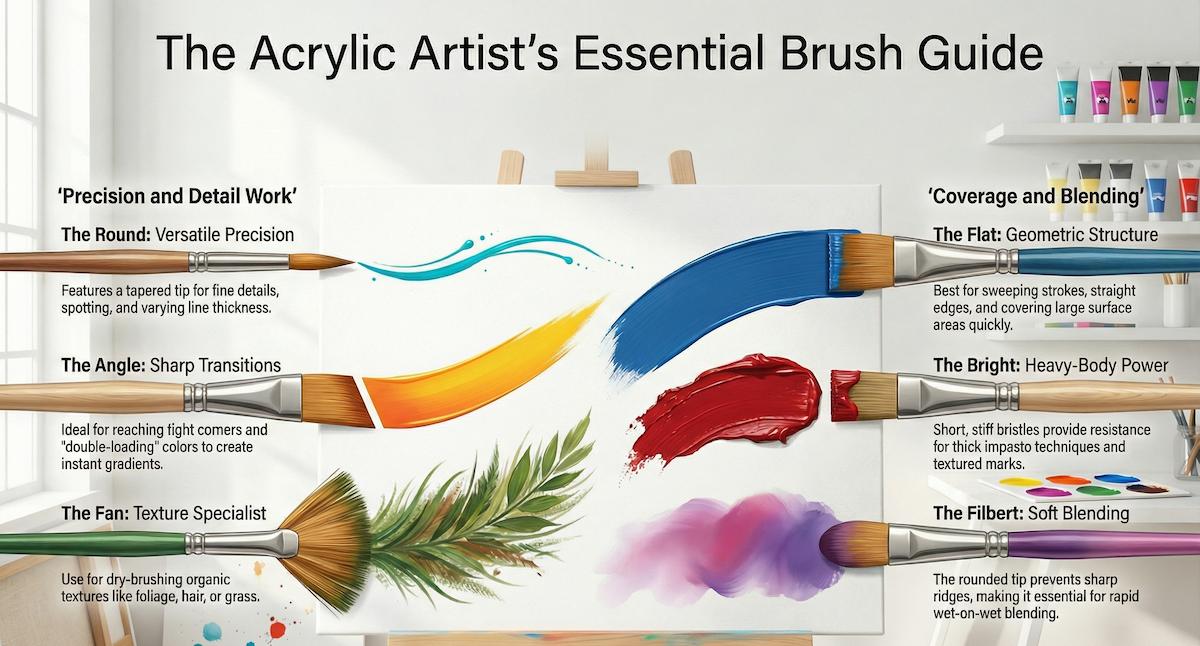
The versatile standard, equally capable of handling fluid acrylics or thinned heavy-body paints.
Shape: Cylindrical at the ferrule, tapering to a fine point.
Characteristics: The belly holds a good amount of water or fluid medium, while the tip allows for precision. Because acrylics dry quickly, rounds are often used for rapid, dynamic sketching.
Best For: Fine details, outlining, spotting, and varying line thickness based on hand pressure.
The primary tool for establishing sharp, geometric structure and covering large surface areas.
Shape: Pinched flat at the ferrule with bristles cut straight across. "Wash" brushes are simply oversized flats.
Characteristics: The longer bristles allow the brush to carry a significant paint load, making it easy to pull long, continuous strokes before the acrylic begins to tack up.
Best For: Sweeping, bold strokes, cutting perfectly straight edges, and applying wide, even layers of acrylic gesso or final polymer varnish.
The aggressive workhorse designed specifically for thick, heavy-body acrylics.
Shape: Pinched flat like a standard flat brush, but the bristles are much shorter—often as wide as they are long.
Characteristics: The short bristles provide a lot of resistance and "snap." They do not bend easily, allowing the artist to push thick, unthinned acrylic paste around without the bristles splaying.
Best For: Impasto techniques, scrubbing paint into the weave of raw canvas, and leaving distinct, highly textured brushmarks.
The essential problem-solver for the biggest challenge in acrylic painting- blending.
Shape: Flat at the ferrule, but the tip is cut into a rounded, oval profile.
Characteristics: Because acrylics dry in minutes, creating soft gradients is notoriously difficult. The filbert lacks the harsh corners of a flat brush, meaning it doesn't leave sharp ridges of paint behind.
Best For: Rapid wet-on-wet blending, softening harsh edges before the paint sets, and painting organic forms like figures, leaves, and clouds.
A precision instrument popular in contemporary acrylic and decorative painting.
Shape: Pinched flat at the ferrule with bristles cut at a sharp diagonal slant.
Characteristics: It acts like a flat brush on its wide side, but the sharp toe allows for needle-like precision. It is also exceptional for "double-loading" (picking up two different colors of acrylic on opposite ends of the brush to paint a gradient in a single stroke).
Best For: Reaching into tight corners, cutting crisp edges against a background, and transitioning effortlessly from a wide stroke to a razor-thin line.
The texture specialist, ideal for dry-brushing techniques.
Shape: Flat at the ferrule, with bristles splayed outward in a wide semicircle.
Characteristics: Because acrylics don't self-level like oils, the fan brush is perfect for creating broken, scattered marks.
Best For: Dry-brushing foliage, grass, and hair. It is also used with a light touch to gently "knock down" or blur the edges of a freshly painted, still-wet acrylic layer.
Summary
The Tech Leader (For heavy body acrylics)
Princeton Catalyst Polytip:
The Innovation: Most synthetic bristles are smooth plastic tubes. Catalyst bristles are "split" at the tip (flagged).
The Benefit: They hold way more paint than standard nylon. They're stiff enough for heavy impasto but smooth enough for detail.
Verdict: One of the best brushes on the market for heavy acrylics.
The "Large Scale" King
Liquitex Freestyle:
The Look: Distinctive large, silver/green handles (often paddle-shaped).
Use: If you paint on big canvases (3ft+), these are essential. They offer "Splalter" brushes and "Paddle" brushes that cover massive areas in seconds.
The Budget Kings
Royal & Langnickel (Zen Series):
The Look: Metallic silver handles.
Verdict: They look cool, feel great, and are quite cheap. They are waterproof (no paint peeling off the handle) and the bristles are surprisingly durable.
Princeton Snap! (White Nylon):
Verdict: The go-to brush for students. Cheap enough to ruin, good enough to sell art with.
Acrylic paint is essentially pigmented liquid glue.
The Danger: If acrylic paint dries in the ferrule, the brush is ruined. The dried plastic pushes the hairs apart, and the brush will never come to a point again.
The "Wet" Rule: While painting, if you are not holding the brush, it MUST be in water. Never lay a dirty acrylic brush on the table for even 2 minutes.
Cleaning: You must use soap (or Masters Brush Cleaner) every time. Water alone does not remove the acrylic resin.