

Introduction To Acrylics
Related Categories
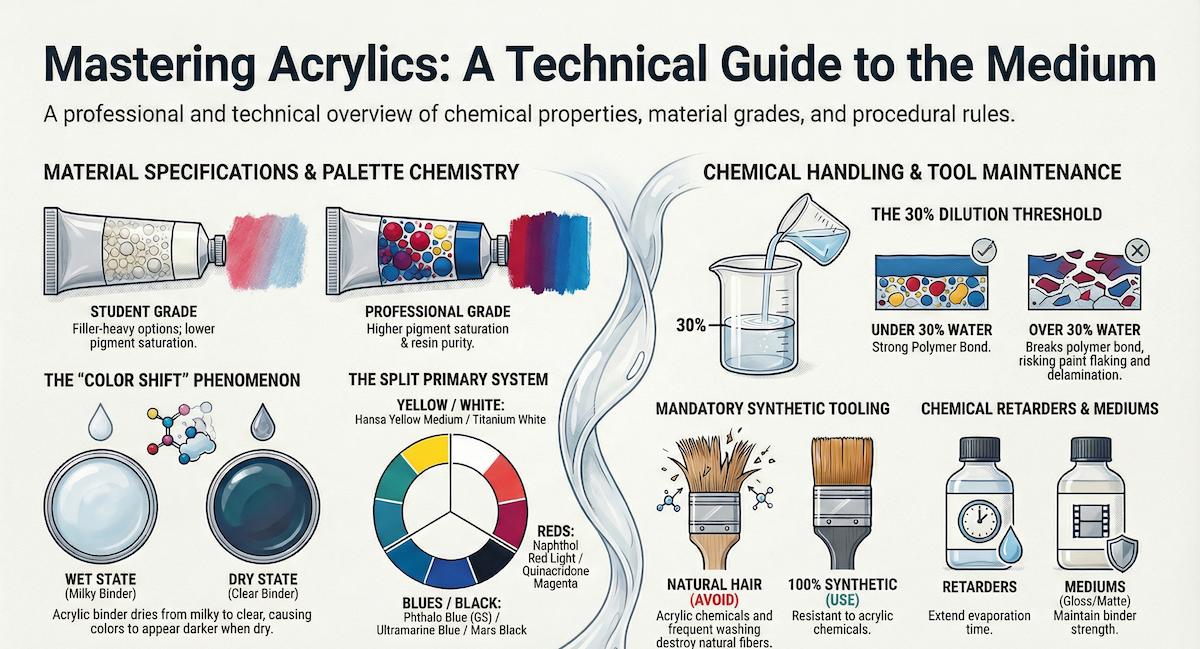
Just like oils, you have two main tiers. Choosing the wrong one can make learning harder.
A. Student Grade (e.g., Liquitex Basics, Golden Open)
What is it? Real acrylic paint, but with less pigment and more fillers.
Pros: Affordable. Great for covering large backgrounds without guilt.
Cons: Less vibrant. Can feel "slippery" or plastic-like.
Verdict: Start here. You will waste a lot of paint learning to control the drying time.
B. Professional Grade (e.g., Golden Heavy Body, Liquitex Professional)
What is it? Pure pigment and resin. No fillers.
Pros: Intense color saturation. The texture holds brushstrokes perfectly.
Cons: Expensive ($15–$30/tube).
Verdict: Upgrade to these one by one as you replace your empty student tubes.
Don't buy the 48-color box set. You only need 7 tubes to mix every color you see.
The Essentials (Heavy Body):
Titanium White (Large Tube): Buy the biggest tube available. You will use it constantly.
Hansa Yellow Medium: A clean, primary yellow.
Naphthol Red Light: A warm, punchy red (like a tomato).
Quinacridone Magenta: A cool, pinkish red. Essential for mixing bright purples.
Phthalo Blue (Green Shade): A cool, powerful blue.
Ultramarine Blue: A warm, deep blue.
Mars Black: A solid, opaque black.
Note on Color Shift: Acrylic binder is milky white when wet but dries clear. This means your colors (especially darks) will usually look darker once they dry. Try mixing a shade lighter than you think you need.
Detailed guides available in the "Brushes" category, but here is the summary.
Material: Synthetic (Nylon/Taklon).
Warning: Try to avoid frequent use of natural hog with acrylics. The chemicals and frequent washing will destroy them, and they can become quite waterlogged during use. Never use delicate natural brushes like sables with acrylics.
The Water Jar Rule: Most acrylics dry in a matter of seconds. If paint dries in the metal band (ferrule) of your brush, the brush is dead.
Habit: Keep a jar of water next to you. Drop the brush in the water the second you stop using it.
Beginners often dilute paint with tap water. This is risky.
The chemistry: Acrylic needs the plastic binder to stick. If you add more than 30% water, you break the chemical bond, and the paint may flake off later.
A. Gloss/Matte Medium
Use: Mix this with paint to make it thinner or transparent (glazing) without losing strength.
B. Retarder / Slow-drying medium
Use: A chemical additive that slows evaporation.
Benefit: Extends working time from 10 minutes to 30+ minutes, allowing you to blend like an oil painter.
A. Canvas Panels
What are they? Canvas wrapped around a cardboard or wooden core.
Why use them: Rigid, cheap, and easy to store. Best for beginners.
B. Stretched Canvas
What is it? Canvas pulled over a wooden frame.
Why use it: The industry standard. It has a "bounce" when you press the brush against it.
C. Paper
Requirement: Must be heavy (300gsm / 140lb) or specific "Acrylic Paper." Thin paper will warp and buckle.
Acrylic dries fast. Your palette is your enemy if you're not careful.
The "Stay-Wet" palette hack
Take a shallow Tupperware container.
Place a wet sponge or folded paper towel at the bottom.
Place a sheet of grease-proof baking paper on top.
Squeeze paint onto the paper.
Result: The moisture wicks up through the paper, keeping your paint wet for hours (or days with the lid on).
Walk into the store and grab these items if you want to start painting today.
The paint (student grade):
Titanium White (large tube)
Hansa Yellow Medium
Naphthol Red Light
Quinacridone Magenta
Ultramarine Blue
Phthalo Blue (Green Shade)
Mars Black
The tools:
Brushes: Size 8 filbert, Size 6 bright, Size 2 round (All synthetic).
Surface: A pack of 9x12" Canvas panels.
Medium: One bottle of "Gloss Medium & Varnish."
Palette: A roll of parchment paper and a Tupperware lid.