
Introduction To Art Markers
Related Categories
The Good: Instant, vibrant color. No setup, no cleanup. They scan and digitize beautifully (which is why Manga and product designers use them).
The Bad: They bleed through paper instantly and are expensive to refill.
The Goal: Learn to create smooth, streak-free gradients that look like print.
This is the most critical technical distinction.
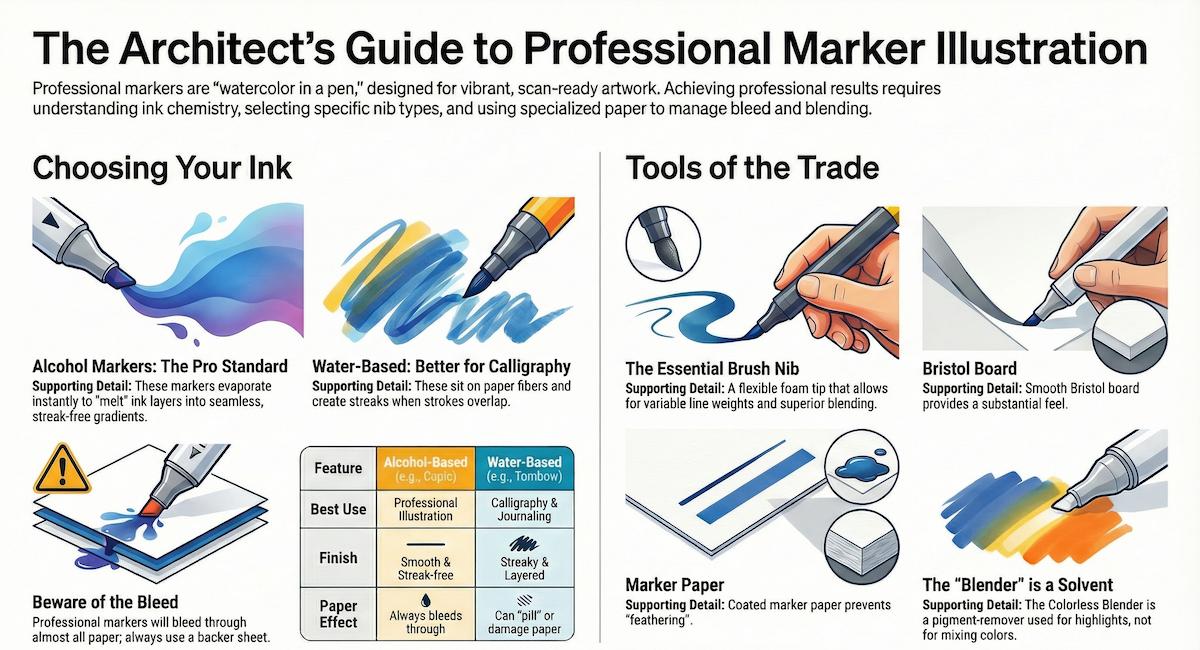
A. Alcohol-Based (The Professional Standard)
Brands: Copic, Ohuhu, Prismacolor.
Chemistry: Ink suspended in alcohol.
Behavior: The alcohol evaporates instantly, allowing the ink to "melt" into the previous layer.
Result: Streak-free. You can color a large area and it looks solid. You can blend two colors seamlessly.
Cons: Strong smell from the fumes. Bleeds through to the back of the paper 100% of the time.
B. Water-Based (For The Calligrapher)
Brands: Tombow Dual Brush, Crayola, Posca.
Chemistry: Ink suspended in water.
Behavior: Sits on top of the paper fibers.
Result: Streaky. If you overlap strokes, you get dark lines. If you layer too much, the paper pills (balls up).
Use: Best for Bullet Journaling and calligraphy, not coloring or illustration.
The tip determines your style.
A. Brush Nib
Feel: Soft, flexible foam tip.
Why use it: It feels like a paintbrush. You can get thin lines (light pressure) and wide strokes (heavy pressure) in one go. Essential for blending.
B. Chisel Nib
Feel: Hard, angled wedge.
Why use it: Filling huge backgrounds quickly.
C. Bullet Nib
Feel: Stiff, rounded point (like a Sharpie).
Why use it: Consistent fine lines. (Most pros prefer the brush nib over this).
Do not use your sketchbook. Markers will soak through 3 sheets.
A. Marker Paper (e.g., Canson Pro Layout)
Tech: Very thin, coated paper.
Why: It holds the ink on the surface so it blends, but prevents it from spreading sideways (feathering).
Note: It will bleed through the back. Put a scrap sheet behind your drawing.
B. Bristol Board (Smooth)
Tech: Thick cardstock.
Why: Very smooth finish. The marker glides. Absorbs more ink than marker paper (so your markers run out faster), but feels more substantial.
Every set comes with a "0" or "Colorless Blender."
What beginners think: "It blends colors together."
The Reality: It's a color remover- a marker filled with pure solvent.
Use: It pushes pigment away. Use it to fix mistakes (push color back inside the line) or to create highlights/texture. It does not mix colors smoothly; use a lighter color to do that.
Budget but great quality:
Brand: Ohuhu Alcohol Markers (Honolulu Series).
Why: They are 90% as good as Copic for 20% of the price. They have a brush nib and are refillable.
Set: Start with the 48-Color Set.
The "Ferrari" Choice:
Brand: Copic Sketch.
Why: The color system is perfect. The nibs are replaceable. The ink is refillable. They last a lifetime.
Set: Extremely expensive ($5–$8 per marker). Buy a "Grey" set and a "Primary" set to start.
The Paper:
Pad: Strathmore 400 Series Marker Paper OR Bristol Smooth.