
Introduction To Drawing & Sketching Paper
The Physics: Copy paper is extremely smooth (to let toner slide over it) and very thin (20 lb / 75 gsm).
The Result: It has no "tooth" to grab graphite, so your darks look grey and shiny. It is also acidic, meaning your drawing will turn yellow and brittle within a few years.
The Fix: You need acid-free paper with specific "tooth" and weight.
These are not synonyms. They are technical grades of paper weight.
1. Sketch Paper
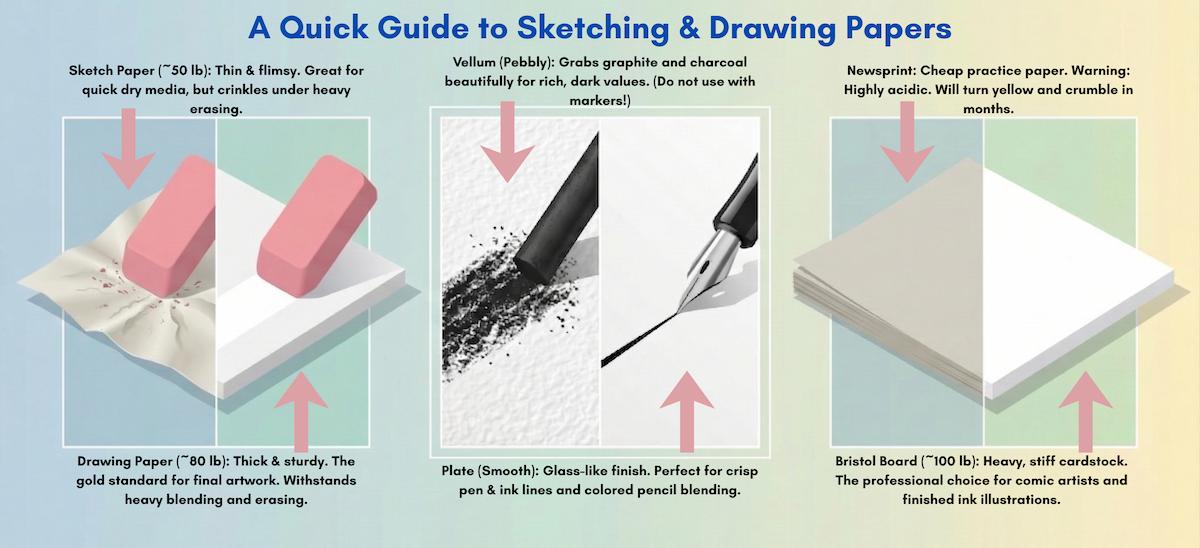
Weight: Light (~50 lb / 74 gsm).
Use: Quick studies, gesture drawing, and dry media (pencil, charcoal).
Limitations: It is flimsy. You cannot erase heavily, or the paper will crinkle and tear. You cannot use ink or markers, or they will bleed through instantly.
2. Drawing Paper
Weight: Medium to heavy (~80 lb / 130 gsm).
Use: Final artwork.
Advantage: It is thick enough to withstand heavy erasing, blending, and even light washes of ink without buckling. If you are spending more than 20 minutes on a drawing, do it on drawing paper, not sketch paper.
The texture of the paper dictates which tool you should use.
1. Vellum / Regular Surface
Texture: Has a slight "pebbly" feel.
Best For: Graphite and charcoal. The texture shaves graphite off the pencil tip, allowing you to build up rich, dark values.
Avoid For: Fine ink liners (the nibs catch on the bumps) or markers (the texture sucks the ink dry).
2. Plate / Smooth Surface
Texture: Feels like glass or hot-pressed steel.
Best For: Pen & ink, markers, and colored pencil.
Why: Ink lines stay crisp without "feathering." Colored pencils can be burnished (polished) to look like a painting because there are no white bumps to fill in.
1. Newsprint
What it is: The cheap, greyish paper used for newspapers.
Use: Strictly for warm-ups and gesture drawing classes.
Warning: It is NOT archival. It will turn yellow and crumble in sunlight within months. Never use this for a drawing you want to keep.
2. Bristol Board
What is it: Heavy cardstock (100 lb / 260 gsm). It is stiff like a business card.
Use: The gold standard for comic book artists, manga, and finished ink illustrations.
Types: Comes in "Vellum" (textured) or "Smooth".
Strathmore is the dominant brand in the US, but their numbering system confuses everyone.
300 Series (Yellow Cover): "Better." Good for students. Acid-free, but sometimes fewer sheets for the price.
400 Series (Brown Cover): "Best." The industry standard for serious artists. The paper is harder and takes more abuse (such as erasing). Buy this one.
500 Series (Professional): Made with 100% cotton fiber. It is archival, luxurious, and expensive. Only buy this for gallery work.
The Value King: Canson XL
The Look: The big fold-over pads with bright Blue (Sketch) or Green (Recycled) covers.
Verdict: This is the best bang for your buck on the market. The paper quality is decent (comparable to Strathmore 300), but you often get 100 sheets for the price of 50.
For Pencil / Charcoal Artists:
Buy a Strathmore 400 Series Drawing Pad (medium surface). It's the perfect balance of tooth and durability. It can take a beating.
For Ink / Marker Artists:
Buy Canson XL Bristol (Smooth). It is thick, smooth, and prevents your expensive markers from bleeding or fraying.
For Everyday Sketching:
Buy a Canson XL Sketch Pad. It's cheap enough that you won't be afraid to make "bad" drawings, which is the key to getting better.
Pro Tip:
If you see "Recycled" sketch paper, be aware that it is often grittier and harder to erase than non-recycled paper. It’s great for charcoal, but annoying for fine detail pencil work.