
Introduction To Erasers
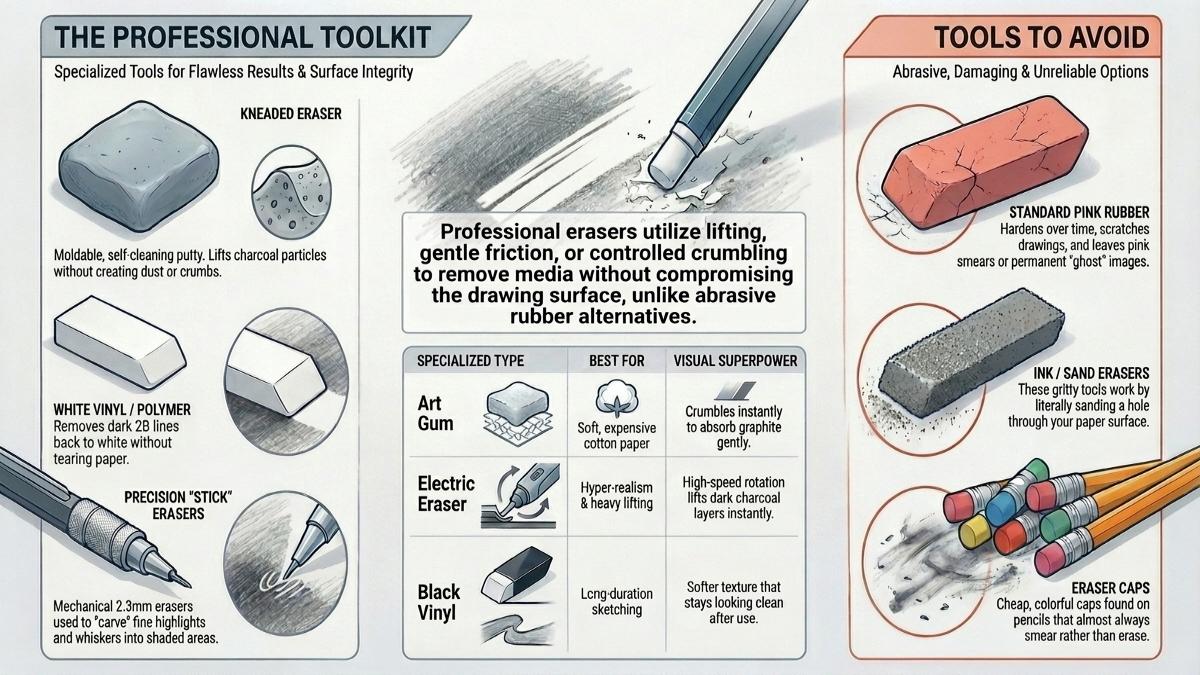
The Physics: Pink rubber is abrasive. It works by scrubbing the top layer of paper fibers off.
The Result: It leaves a pink smear, tears the paper surface, and creates a "ghost" image. Worse, the rubber hardens over time and scratches your drawing.
The Fix: Throw them away. Professional artists use specific erasers that lift marks off the paper rather than sanding the paper down.
This is the most essential tool for any artist working in charcoal or soft graphite.
What they are: Grey, moldable putty. It feels like dough or gum.
How it works: It is sticky. It does not rub; it lifts. You press it onto the paper, and it pulls the charcoal particles off.
The Superpower: Zero crumbs. It creates no dust.
The Maintenance: When it gets black and dirty, you pull it apart, stretch it, and fold it back together (knead it) to reveal a fresh, clean surface. It is "self-cleaning" until it eventually gets too saturated and dies.
Best Brands: Prismacolor or Faber-Castell.
These are the rectangular white blocks you see in art stores.
What they are: Soft vinyl or plastic.
How it works: They erase by friction, but are much gentler than pink rubber. The material rolls up into long "strings" or strands rather than fine dust.
The Superpower: Total removal. It can erase a dark 2B pencil line back to pure white paper without tearing the surface.
The Flaw: It creates waste (the strings) that you have to sweep away.
Best Brands: Pentel Hi-Polymer (The gold standard) or Staedtler Mars Plastic.
These are the tan, crumbly, translucent squares.
How it works: It is designed to break down instantly. As it crumbles, the crumbs absorb the graphite.
The Use: It is incredibly gentle. Use this if you are working on expensive, soft cotton paper that tears easily.
The Mess: It creates a massive pile of sand-like dust. You need a "Drafting Brush" to sweep it off, or you will smudge your art with your hand.
The Problem: A big block eraser is clumsy. You can't erase a tiny highlight in an eye without erasing the whole eye.
The Solution: Tombow Mono Zero.
What it is: A mechanical pencil, but instead of lead, it holds a tiny 2.3mm cylinder of high-quality vinyl eraser.
The Use: Drawing with white. You use this to "carve" whiskers, hair, and highlights out of a dark shaded area. It is precise enough to erase a single line of cross-hatching.
What they are: A battery-operated motor that spins a tiny eraser nib at high speed.
The Use: Heavy lifting. If you put down a layer of charcoal that is too dark, this machine will lift it instantly without you having to scrub.
Target Audience: Architectural drafters and hyper-realism artists who need sharp, intense highlights.
Brand: Sakura makes the industry standard.
You will see black versions of vinyl erasers.
Are they different? Often, yes. They are usually slightly softer and stickier, meaning they require less pressure to work.
The Visual Benefit: They don't look dirty. A white eraser looks gross after one use; a black eraser always looks clean.
The Must-Have Kit:
Pentel Hi-Polymer (Block): For general error correction and cleaning up sketches.
Kneaded Eraser (Grey): For shading, lightening areas without removing them completely, and working with charcoal.
Tombow Mono Zero (Round Tip): For final details and highlights.
The Avoid List:
Eraser Caps: The cheap colorful caps you put on pencils. They always smear.
Ink / Sand Erasers: The gritty blue ones. They work by literally sanding a hole in the paper. Never use them on art.