Introduction To Monochrome Pencils
Related Categories
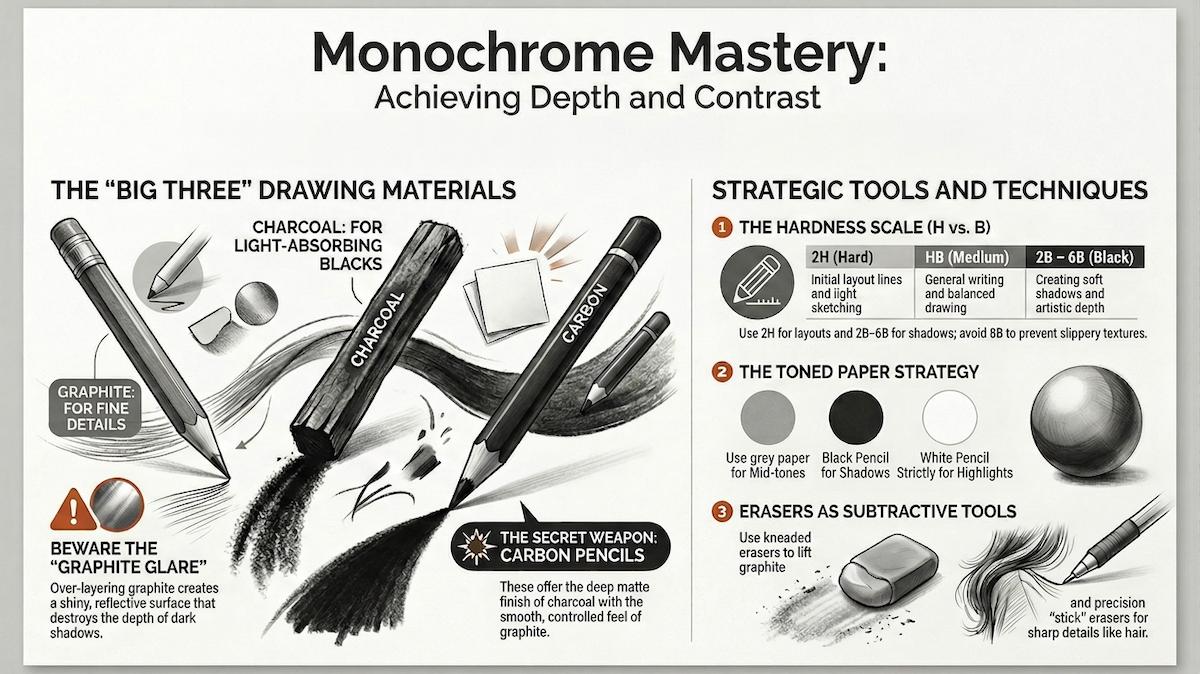
The Good: You can create photorealistic depth using just one color. It teaches you the most important rule in art: Value matters more than color.
The Bad: "Graphite Glare." If you layer graphite too heavy, it becomes shiny and reflective, killing the depth of your black shadows.
The Goal: Master the "Matte Black" by knowing when to switch from graphite to charcoal or carbon.
Most beginners think "pencil" just means graphite. There are actually three distinct types of black pencils.
A. Graphite (The Standard)
Look: Metallic grey (Shiny).
Behavior: Smooth, glides on paper, easy to erase.
Pros: Unmatched control for fine details and light shading.
Cons: The Glare. You can never get a true "black" with graphite; it will always reflect light like a mirror.
B. Charcoal Pencil (The Void)
Look: Dead matte black.
Behavior: Dry, scratchy, and dusty.
Pros: Absorbs light. It is the darkest black possible.
Cons: Smudges if you look at it wrong. Hard to adhere to the paper.
C. Carbon / Oil Pencil (The Secret Weapon)
Look: Matte black (like charcoal) but with a binder (like graphite).
Examples: Conté à Paris "Pierre Noire" or Wolff's Carbon.
Behavior: It feels creamy like a colored pencil but looks black like charcoal.
Verdict: Buy one of these. It allows you to draw deep, permanent blacks without the mess of charcoal dust.
You don't need all 20 grades.
H (Hard): The "Architect." Hard clay content. Keeps a sharp point forever.
Use: 2H for initial layout lines that are easy to erase.
HB (Medium): The "Writer."
B (Black): The "Artist." Soft graphite content.
Use: 2B for general drawing. 4B or 6B for shadows.
The Trap: Don't buy an "8B" or "10B" Graphite pencil hoping for black. It will just be extremely shiny and slippery. Switch to carbon/charcoal for those darks.
White pencils are useless on white paper. They are magic on toned paper.
The Strategy: Instead of shading down to black on white paper, use grey or tan paper (the mid-tone).
Use black for shadows.
Use white only for highlights.
Leave the paper for the middle values.
Result: Your drawing looks 3D in half the time because you aren't fighting the white background.
In monochrome, an eraser is a white drawing tool.
A. Kneaded Eraser (The "Putty")
Essential. It lifts graphite without leaving crumbs. You can mold it into a needle point to pick out hair highlights.
B. Mono Zero (The "Stick")
What is it? A tiny eraser in a mechanical pencil body (by Tombow).
Use: Essential for cleaning up sharp edges and erasing tiny details like eye reflections.
Walk into the store and grab these specific items.
The Pencils:
Graphite: Staedtler Mars Lumograph (Get a 2H, HB, and 4B). Note: The "Lumograph Black" line is special—it contains carbon to reduce glare.
Charcoal/Carbon: General's Charcoal (2B) OR a Conté à Paris Pierre Noire (B).
White: General's White Charcoal or Faber-Castell Pitt Pastel Pencil (White).
The Surface:
Paper: Strathmore Toned Tan or Toned Grey Sketchbook (400 Series).
The Tools:
Eraser: Tombow Mono Zero (Round tip) + a kneaded eraser.
Blending: A Tortillon (paper stump) for smoothing charcoal (do not use your fingers; the oil on your skin ruins the paper).