
Introduction To Palette Knives
For the technical painter, understanding the geometry and metallurgy of these tools is critical for achieving clean impasto, sharp architectural edges, and precise color mixing.
While brushes manipulate paint by dragging it through thousands of individual fibers, knives apply paint as a structural solid. Using a knife allows for the application of paint without the textural interference of bristles or the need for solvent dilution.
The terms are often used interchangeably, but structurally, they are two completely distinct tools designed for different physics.
The Palette Knife:
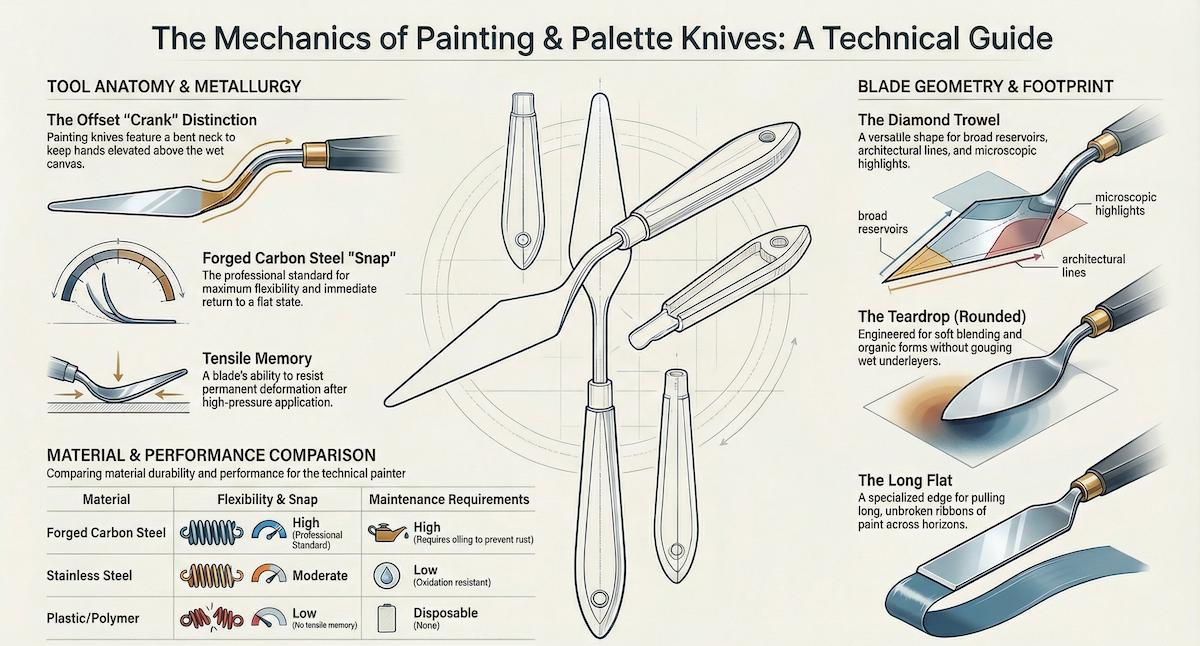
Characterized by a completely flat, straight blade extending directly from the handle. It is engineered exclusively for mixing heavy pigments on a glass or wood palette, scraping surfaces clean, and cutting through dense mediums. If you attempt to paint with it, your knuckles will drag through the wet paint on your canvas.
The Painting Knife:
Characterized by a "cranked" or offset neck. This distinct bend acts as a physical bridge, dropping the blade down while keeping your hand and knuckles safely elevated above the wet surface of the artwork.
The performance of a knife is dictated by its flexibility and its "memory" (how quickly it snaps back to a flat zero-state after being bent).
Forged Carbon Steel: The professional standard. These blades are forged from a single piece of steel and tapered toward the tip. They offer maximum flexibility and an immediate "snap," allowing for highly responsive, pressure-sensitive application. They require maintenance (oiling) to prevent rust.
Stainless Steel: The modern alternative. They are highly resistant to oxidation and harsh solvents, making them easier to maintain, though they often lack the extreme, delicate flex of pure carbon steel.
Plastic/Polymer: Disposable tools. They lack tensile memory, snap easily under pressure, and have thick, blunt edges that cannot cut a sharp line or lay down a microscopic glaze of color.
The shape of the blade determines the footprint of the paint applied to the canvas.
The Diamond (Trowel):
The versatile workhorse. The wide belly holds a massive reservoir of paint for broad strokes, the straight edges can scrape away mistakes or cut architectural lines, and the sharp point can drop microscopic highlights onto an eye or a water droplet.
The Teardrop (Rounded): Because it has no sharp corners, this blade is engineered for soft blending. It allows the artist to press heavy paint into a wet underlayer without the corners gouging or scratching the paint beneath it. Ideal for clouds, skin tones, and organic forms.
The Long Flat: A highly specialized blade featuring a long, rectangular edge. It is used to pull long, unbroken ribbons of paint across a surface. Essential for painting distant horizons, ocean lines, or mechanical structures.