
Introduction To Pencil Sharpeners
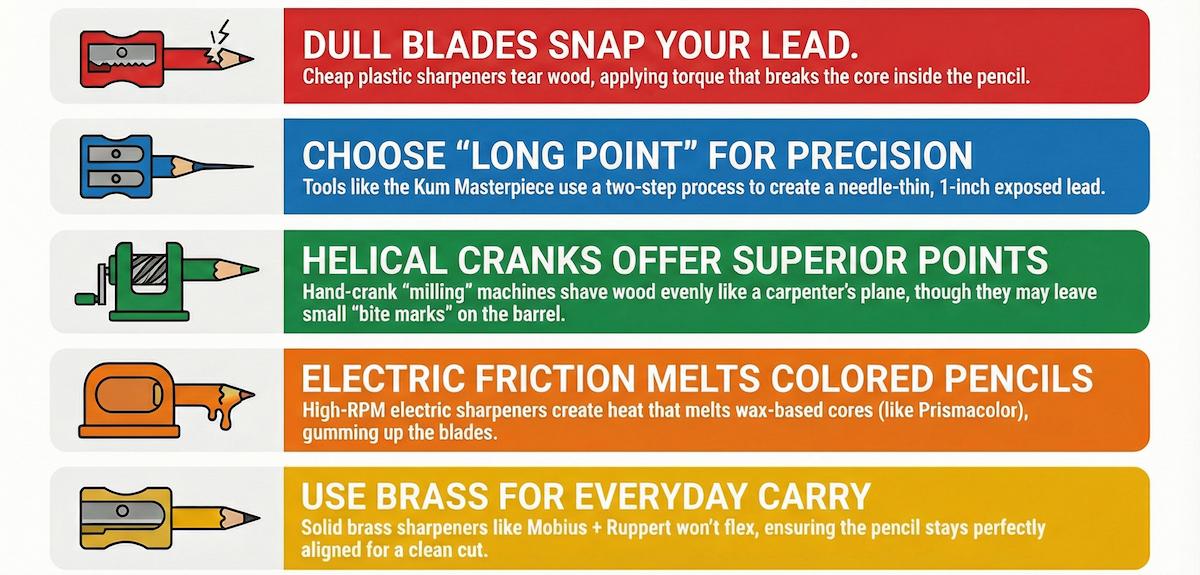
Why: Cheap sharpeners use stamped metal blades that dull after 5 uses. Once dull, they don't cut the wood; they tear it. This applies torque to the lead, snapping it inside the casing.
The Result: You think the pencil is broken ("bad lead"), but actually, your sharpener is breaking it every time you twist.
The Fix: You need a replaceable German blade or a helical cutter (milling mechanism).
These are the small blocks you carry in your pocket. The quality of the blade is everything.
1. Mobius + Ruppert (M+R) Brass
The Look: Heavy, gold-colored solid brass.
The "German" Edge: M+R uses ultra-hard steel blades. Because the body is made of solid brass, it doesn't flex. This keeps the pencil perfectly aligned with the blade, preventing off-center sharpening (where wood covers one side of the lead).
The "Bullet" vs. "Wedge": The Bullet shape is heavier and easier to grip. The Wedge is classic. Both use the same blades.
2. Kum "Long Point"
The Concept: Standard sharpeners cut a short, stubby cone. A "Long Point" sharpener cuts a needle-thin, 1-inch long spike.
How it works: It has two holes.
Hole 1: Removes only the wood.
Hole 2: Sharpens only the lead.
Why use it: A longer point allows you to shade with the side of the lead and draw longer without stopping to sharpen.
The Product: Kum Masterpiece or Kum Automatic Long Point.
These clamp onto your desk. They do not use a flat blade.
The Physics
Mechanism: Inside is a heavy metal cylinder with spiral teeth (a helix). It spins around the pencil, gently shaving the wood away like a carpenter's plane.
The Benefit: It creates the most perfect, concentric, long point possible. It rarely breaks leads because the force is evenly distributed.
The "Clutch" Warning
The Teeth: To hold the pencil still, these sharpeners use "jaws" (a clutch) that bite into the pencil barrel.
The Result: They leave little "bite marks" on the paint of your beautiful pencils. If you're a pencil collector who hates scratches, avoid these.
The Brands
Mitsubishi / Uni (KH-20): The Japanese gold standard. Smooth, quiet, and creates a lethal point.
Dahle 133: A solid German alternative that allows you to adjust the "bluntness" of the tip (good for soft colored pencils).
Electric sharpeners are for speed, but they present dangers for artists.
The "Wax" Danger
Colored Pencils: They contain wax or oil. When an electric sharpener spins at 1000 RPM, friction creates heat.
The Meltdown: The heat melts the wax core. It gums up the blades, and the soft lead snaps instantly.
The Rule: Never use a cheap office electric sharpener for Prismacolor or Polychromos.
The Exception: Afmat
The Brand: Afmat makes electric sharpeners specifically for artists.
The Feature: They usually use a slower, high-torque helical cutter that doesn't overheat the lead. Some models (Long Point) are designed specifically for charcoal and colored pencils.
If you go to an art academy (Atelier), they might confiscate your mechanical sharpeners.
The Technique
The Knife: Use an X-Acto blade or utility knife to carve away 1–2 inches of wood, exposing a long cylinder of lead.
The Sandpaper: Rub the lead on a sandpaper block to sharpen it to a needle point—or a chisel tip, or a rounded tip.
Why do it? Total control. You can expose 2 inches of lead for sweeping gestural marks, which is impossible with a mechanical sharpener.
The Everyday Carry:
Buy the Mobius + Ruppert (M+R) "Pollux" or "Castor".
Why: It makes a slightly concave point that is razor sharp. It's made of solid brass and will last 50 years if you change the blades.
The Long Point King:
Buy the Kum Masterpiece.
Why: It comes in a neoprene pouch. It removes wood so cleanly it produces a continuous shaving. It creates the longest, deadliest point of any handheld sharpener.
The Studio Desk Tool:
Buy the Mitsubishi KH-20 Hand Crank.
Why: It's very satisfying to use. It stops automatically when the pencil is sharp. It handles fragile pastel pencils better than any blade sharpener.
For Colored Pencils:
Stick to hand-crank or handheld.
Why: Colored pencil cores are soft. Electric sharpeners eat them too fast. A Dahle 133 allows you to set a blunt point, which is stronger for coloring and shading.