Introduction To Technical Drawing Pencils
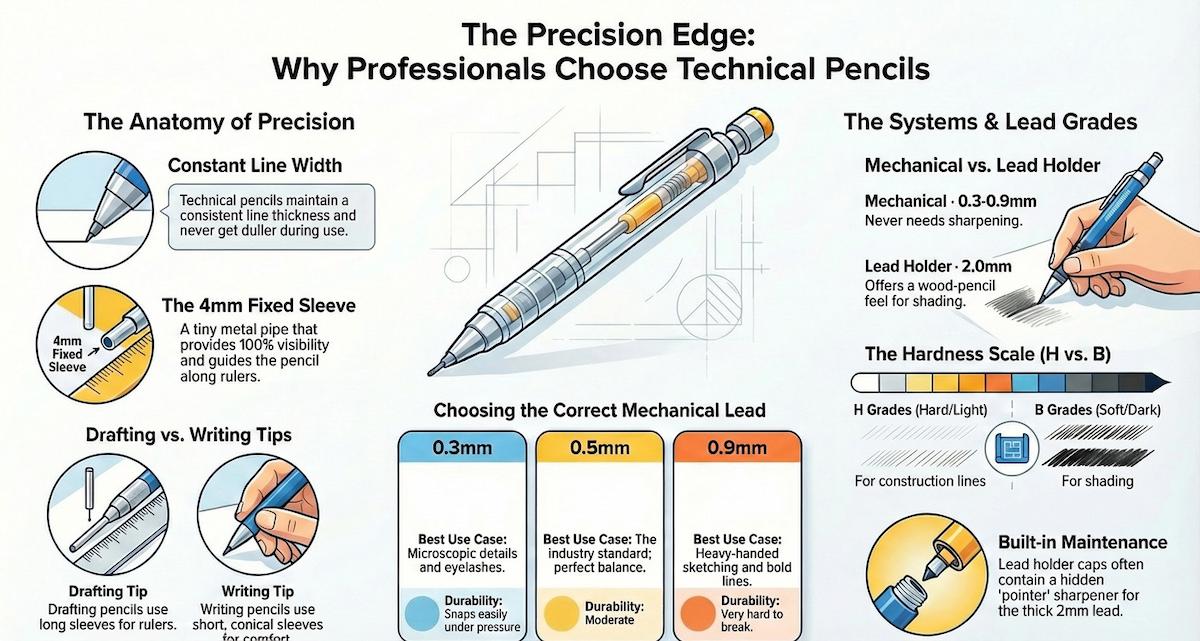
The Physics: As you draw with a wood pencil, the tip dulls immediately. Your line starts thin and ends thick. You spend too much of your time sharpening.
The Solution: Technical (or mechanical) pencils. They maintain a constant line width forever. They never get shorter, and they balance perfectly in the hand.
The defining feature of a technical pencil is the lead sleeve—the tiny metal pipe at the tip.
Drafting Pencils: Have a long (~4mm) fixed sleeve.
Why: This allows you to run the pencil along a ruler or template without the wood hitting the edge. It gives you 100% visibility of exactly where the lead touches the paper.
The Danger: If you put a fixed-sleeve pencil in your pocket, it will stab your leg or bend the tip.
Writing Pencils: Have a short, often conical sleeve.
1. The Mechanical Pencil (0.3mm to 0.9mm)
What it is: Uses thin lead sticks that push through a mechanism.
Use: Precision. Because the lead is so thin, you never have to sharpen it.
Sizes:
0.3mm: For microscopic details and eyelashes. (Snaps easily if you press hard).
0.5mm: The industry standard. The perfect balance.
0.7mm: Good for sketching and bold lines.
0.9mm: Heavy hand? Use this. It’s hard to break.
2. The Lead Holder (The "Clutch" Pencil)
What it is: A mechanical casing that holds a thick 2.0mm lead (the same thickness as a wood pencil).
The Mechanism: It has "jaws" (a clutch) that grab the lead. When you press the button, the lead drops out (gravity-fed).
Why use it: It combines the feel of a wood pencil (shading capabilities, thick lead) with the balance of a mechanical tool.
The Secret: The cap usually has a built-in sharpener (pointer) inside the button to sharpen the 2mm lead.
Technical pencils allow you to swap lead grades instantly (often marked by a dial on the pencil).
H Grades (2H, 4H): Hard clay content.
Result: Light, grey lines. They don't smudge. Used for initial construction lines that you will ink over later.
HB: The middle ground
B Grades (2B, 4B): Soft graphite content.
Result: Dark, rich black lines. They smudge easily. Used for shading and finishing.
Note: Most mechanical leads sold in stores are HB. You must specifically order 2B or 4H leads if you want them.
The "Standard" (Pentel)
Pentel GraphGear 1000:
The Killer Feature: Retractable tip. When you clip it to your pocket, the entire metal tip sucks inside the body. No stabbed legs, no bent tips.
The Feel: Heavy metal body with rubber grip inlays.
Verdict: The best all-rounder. It is the most practical pencil for students and traveling artists.
Pentel P205: The classic sharp, black plastic pencil. Cheap, reliable, but lightweight.
The Top Tier (Rotring)
Rotring 600:
The Look: Matte black or silver. Hexagonal brass body.
The Feel: It feels like a surgical instrument but built like a tank. It is heavy and cold. The knurled grip is aggressive and non-slip.
The Flaw: The tip is fixed. If you drop it tip-down, it bends, and the pencil is ruined.
Verdict: The status symbol for architects and designers.
The "Innovation" (Uni)
Uni Kuru Toga:
The Problem: With normal pencils, the lead wears down on one side, creating a "chisel" tip that makes your line get wider.
The Fix: The Kuru Toga has an engine inside that rotates the lead slightly every time you lift the pencil. It keeps the tip perfectly conical and sharp automatically.
Verdict: Genius for writing and consistent hatching.
The "Clutch" Classic (Staedtler)
Staedtler Mars Technico 780:
The Look: The classic blue 2mm holder.
Verdict: Indestructible. If you want to sketch loosely but hate sharpening wood pencils, this is your tool.
The Everyday Carry:
Try the Pentel GraphGear 1000 (0.5mm).
Why: The retractable tip saves the pencil (and your pants). It offers professional weight and balance for ~$10.
The Desk King:
Try the Rotring 600 (0.5mm).
Why: If it lives on your desk and won't be dropped, it is the most satisfying drawing tool ever made. The weight forces you to slow down and be precise.
The Sketcher:
Try the Staedtler Mars Technico (2mm lead holder) and a pack of 2B Leads.
Why: It allows for expressive shading that thin mechanical pencils can't do. It is essentially a wood pencil that never gets short.