

Introduction To Tempera
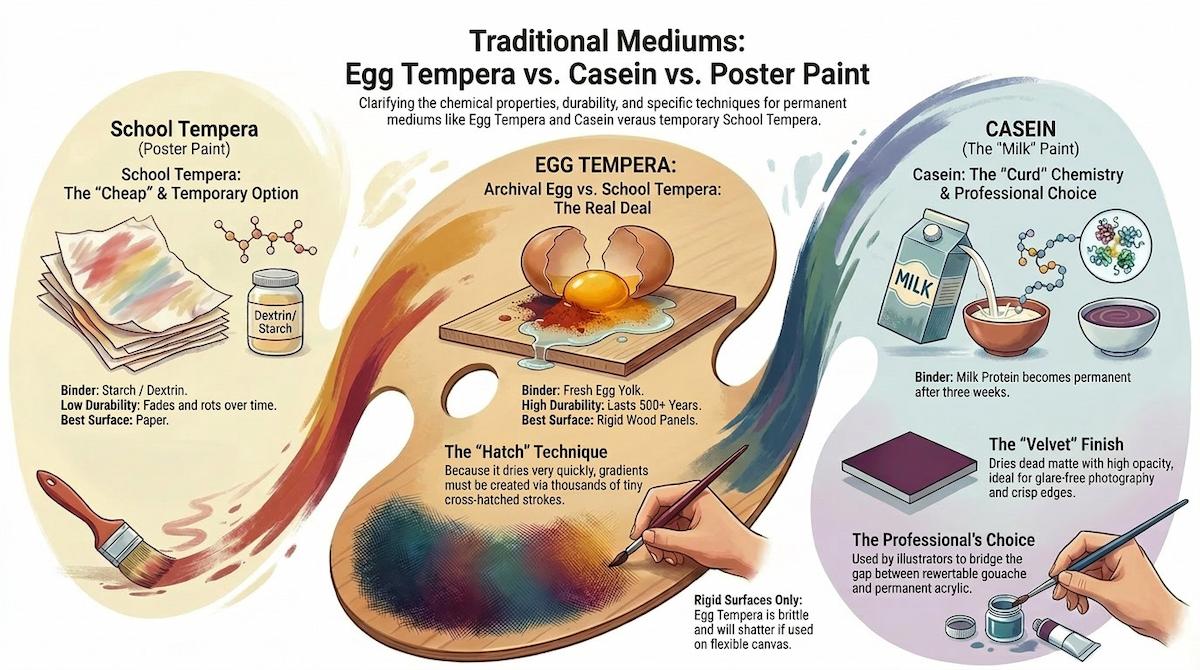
School Tempera: Cheap, washable poster paint used in kindergarten. It is made of starch and water. It will rot, fade, and crack.
Egg Tempera: The archival medium used by Botticelli and Michelangelo. It is made of pure pigment and egg yolk. It lasts for 500+ years.
The Rule: If it costs $3 for a bottle, it is poster paint. If it costs $15 for a tiny tube, it is the real deal.
What it is: Pigment mixed with a cheap binder like starch, dextrin, or gum water.
The chemistry: It is designed to be temporary. It is non-toxic and washable from clothes.
The trap: Because it contains organic starches, it is prone to mold if stored damp. It is fugitive, meaning the colors will fade rapidly in sunlight.
Performance: It dries chalky and brittle. If you paint it too thick, it cracks and falls off the paper.
Verdict: Strictly for children. Never use this for artwork you intend to keep or sell.
This is the medium of the old masters and religious icons.
The Physics
Ingredients: Pure pigment powder mixed with fresh egg yolk and water.
Curing: The oil in the yolk oxidizes and cross-links, creating a protein bond that is harder than acrylic and more stable than oil paint. It does not yellow over time.
The look: It has a unique satin sheen. It is translucent and glows from within.
The Technique (The "Hatch")
No blending: You cannot blend egg tempera like oil paint. It dries instantly (in about 10 seconds).
Cross-hatching: To create gradients, you make thousands of tiny strokes (hatching) layered over each other. It is a linear, disciplined medium.
The Surface Rule- Use Rigid Surfaces Only
Warning: Egg tempera is brittle. If you paint it on flexible canvas, it will shatter like glass.
Requirement: You must use a rigid panel (like wood or Ampersand Claybord) with a traditional gesso ground.
The Brands
Sennelier: One of the few companies that sells tube egg tempera (stabilized with oil). It is convenient but behaves slightly differently from fresh homemade tempera.
DIY: Most professional tempera artists will buy dry pigment and eggs and mix it fresh daily.
Before acrylics were invented in the 1950s, commercial illustrators used casein.
The Physics Of The "Curd" Factor
Ingredients: Pigment mixed with casein (milk protein) and an alkali (like lime or borax).
The smell: It has a distinct, earthy, milky smell.
The curing:
In a wet state: It's water-soluble like gouache. You can rework it.
In a dry/cured state: After 2–3 weeks, the chemical reaction makes it permanent and water-resistant. It becomes rock hard.
Why Use It? For The "Velvet" Finish
Matte: It dries dead matte. It photographs beautifully because there is no glare (which is why illustrators loved it).
Opacity: It covers aggressively. It is creamy, flows beautifully, and allows for clean, crisp edges.
The link: It bridges the gap between gouache (which is rewettable) and acrylic (which is permanent).
The Surface Rule
Like egg tempera, casein is brittle. It works best on rigid panels or heavy watercolor board. It will crack on loose canvas.
The Brand
Richeson (Shiva): This is the last major brand keeping the tradition alive. Their casein line is legendary among retro-style artists and concept designers.
For the history buff / pro:
Try Richeson Casein.
Why: It offers a unique painting experience that plastic acrylics can't match. The "velvety" texture is addictive. It forces you to paint boldly.
For the "Icon" painter:
Buy Sennelier Egg Tempera or dry pigment.
Why: If you want that specific, glowing, spiritual look of early Renaissance art, there is no substitute. Acrylic can mimic it, but it lacks the depth.
For the Student:
Use gouache instead of poster paint.
Why: Gouache is the professional version of opaque watercolor. It behaves similarly to poster paint (matte, opaque) but is lightfast and archival. Stop using "school tempera" the moment you graduate from 5th grade.