Introduction To Watercolor Brushes
Related Categories
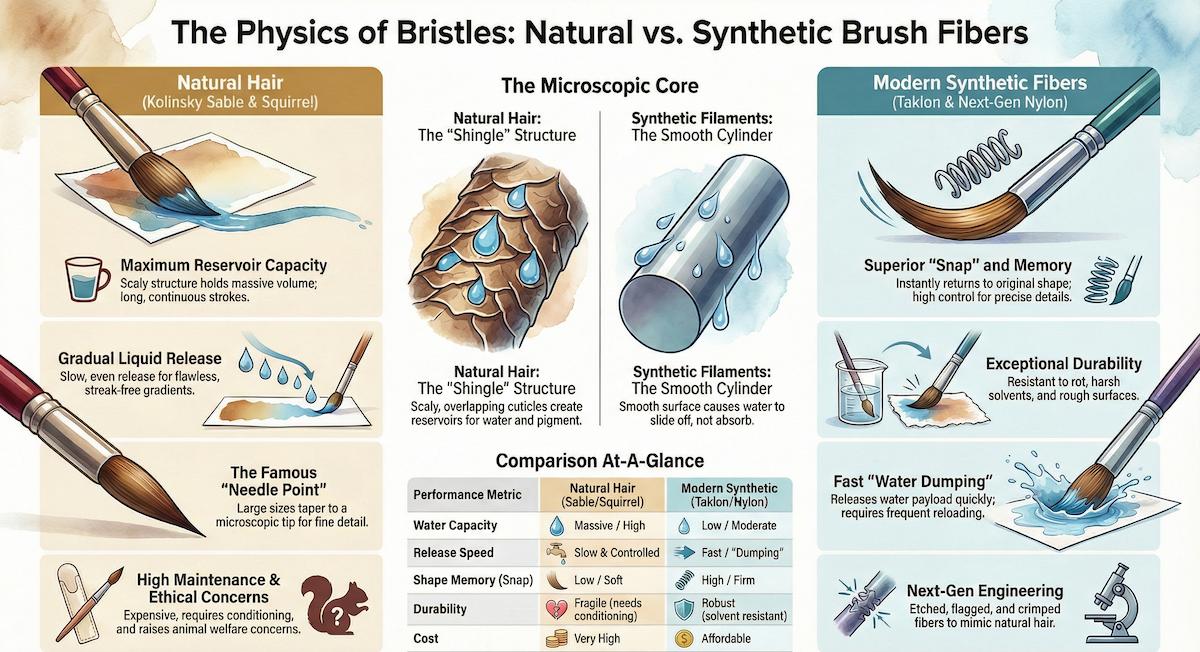
The Physics: Watercolor painting is about "controlled flooding." You need a brush that acts like a tank—holding a massive belly of water—but feeds it out slowly through a fine point.
The Reality: Cheap brushes hold no water. You dip the brush, paint one inch, and it runs dry. You'll spend most of your time dipping back into the cup rather than painting.
The Rule: You are better off buying one expensive brush ($15–$20) than a set of 20 cheap ones.
1. Kolinsky Sable
Source: Winter coat of the male Kolinsky weasel (from Siberia).
The Magic: It has perfect "snap" (returns to a point instantly) and holds a massive amount of water.
The Cost: Astronomically expensive. A single large brush can cost $300.
Verdict: The Ferrari. Lovely to own, but unnecessary for beginners given modern technology.
2. Squirrel
The Magic: Holds even more water than sable. It is incredibly soft.
The Flaw: It has zero snap. It's floppy.
Verdict: Excellent for painting big skies and washes, but not good for details.
3. Modern Synthetics
The Tech: In the past several years, synthetic fibers have cracked the code. Brands now make Faux Squirrel and Faux Sable.
The Benefit: They are 90% as good as natural hair, 100% cruelty-free, and 70% cheaper.
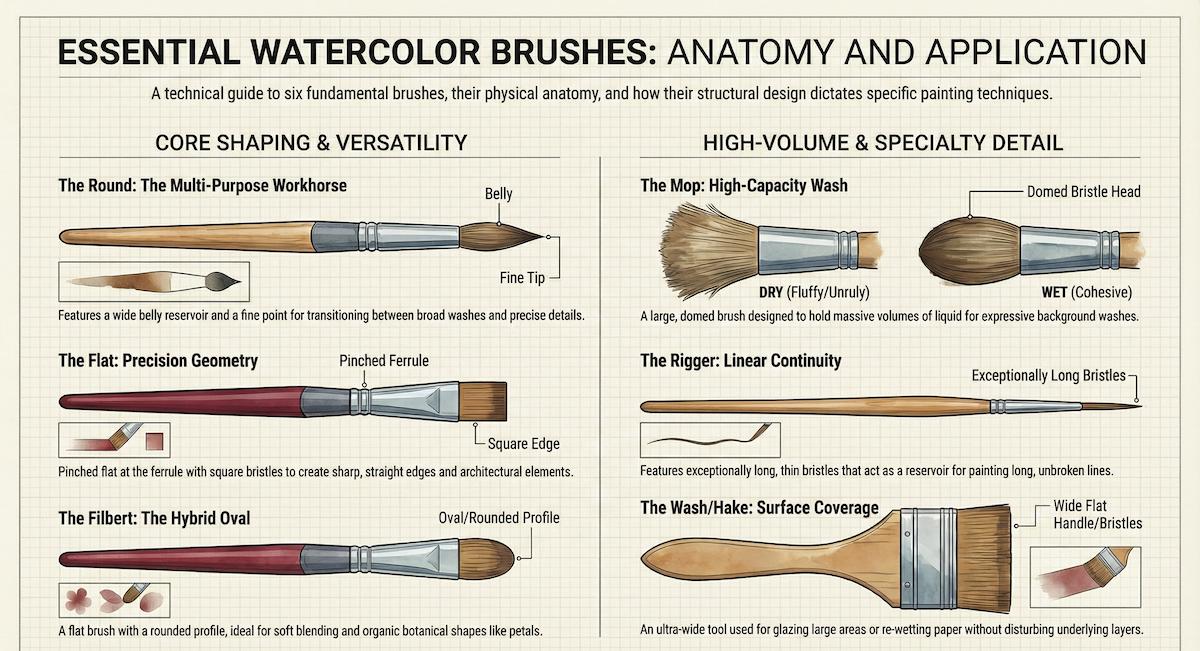
The absolute workhorse of watercolor painting. If an artist only owns one brush, it is almost always a round.
Shape: Cylindrical at the ferrule (base) tapering to a fine point.
The Belly: The middle section is wider to hold a large reservoir of water and pigment.
Best For: Unmatched versatility. Pressing down utilizes the belly for broad strokes and washes, while lifting up allows the fine tip to execute precise details.
A precision tool designed for controlled, geometric, and linear work.
Shape: Pinched flat at the ferrule with bristles cut in a straight, square line.
Water Capacity: Holds less water than a round brush of the same size.
Best For: Creating sharp, straight edges, architectural elements, and sweeping flat washes. Using the absolute edge of the brush creates thin, crisp lines.
The heavy lifter for moving large volumes of liquid.
Shape: Large, thick, and domed. They often appear fluffy or unruly when dry but form a cohesive shape when wet.
Material Note: Traditionally made of highly absorbent natural hair (like squirrel) or advanced synthetics designed to mimic that extreme thirst.
Best For: Wetting large sheets of paper, painting massive sky gradients, and laying down broad, loose, expressive background washes.
A hybrid brush that offers the coverage of a flat with the softness of a round.
Shape: Pinched flat at the ferrule, but the bristles are cut into an oval or rounded profile.
Best For: Botanical painting (like petals and leaves), figure painting, and blending. Because it lacks the sharp corners of a flat brush, it leaves softer, less noticeable brushstrokes.
A specialty brush designed for long, continuous, fine lines.
Shape: Very thin with exceptionally long bristles.
The Physics: The extended length of the bristles acts as a reservoir, holding enough liquid paint to complete a long stroke without running dry or breaking the line.
Best For: Tree branches, tall grasses, boat rigging (where the name originates), animal whiskers, and signing the artwork.
The ultimate tool for large-scale surface coverage.
Shape: Very wide and flat. "Wash" brushes look like standard wide flat brushes, while "Hake" brushes are traditional Japanese brushes with a flat wooden handle and soft, stitched goat hair.
Best For: Glazing massive areas with a single, uniform color, re-wetting an entire canvas, or sweeping up excess pools of water without disturbing the layers underneath.
The Synthetic Kings
Princeton Neptune (The "Faux Squirrel"):
Feel: incredibly soft and thirsty. Great for loose, watery styles.
Cost: Very affordable. The #1 recommendation for students.
Princeton Aqua Elite / Heritage (The "Faux Sable"):
Feel: Stiffer. Has more "snap." Better if you like control and tight details.
Escoda Versatil:
Status: A high-end synthetic from Barcelona. It mimics Kolinsky Sable almost perfectly.
The Hybrid "Cult Favorite"
Silver Brush Black Velvet:
The Mix: 50% Natural Squirrel / 50% Synthetic.
The Result: You get the massive water capacity of the squirrel with the snap/point of the synthetic.
Visual: Distinctive black handle and black bristles. This is arguably the most popular brush on YouTube / social media.
The Legend Tier
Winsor & Newton Series 7:
History: Originally commissioned by Queen Victoria.
Quality: The finest Kolinsky Sable in the world.
Warning: Only buy this if you are a professional. Putting acrylic or ink on this brush is a financial tragedy.
The Absolute Best Start:
Buy one Princeton Neptune Round (Size 8 or 10).
Why: It holds enough water to paint a whole sky, but points sharply enough to paint an eye. It costs ~$12 and replaces an entire kit of cheap brushes.
The Upgrade Pick:
Silver Black Velvet Round (Size 8).
Why: The unique blend makes it feel alive in your hand. It is the perfect balance of floppy and snappy.
Care Rule #1:
Never leave a brush sitting tip-down in the water cup.
Why: The weight of the handle bends the bristles against the bottom of the cup. Within 5 minutes, you will have a permanent hook in the tip, and the brush is ruined forever. Always lay them flat to dry.