Introduction To Watercolor Mediums
Related Categories
This is the only medium that 99% of watercolorists actually own.
Liquid Frisket / Masking Fluid
What it is: Liquid latex rubber (usually ammonia-based).
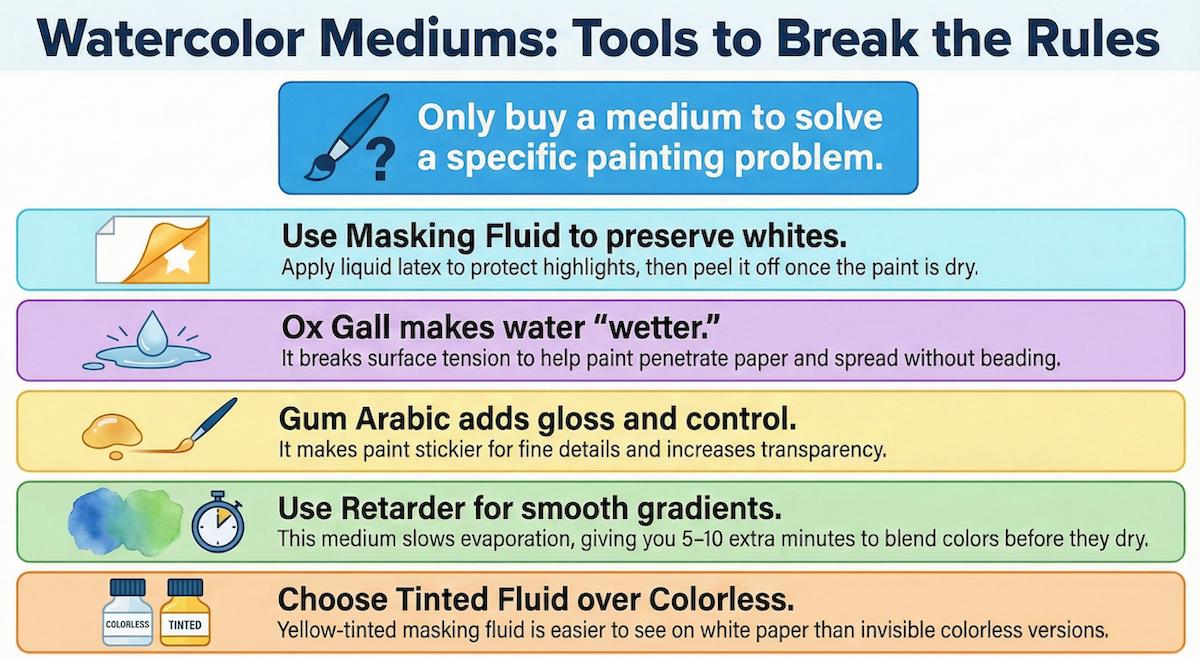
The Use: Watercolorists rarely use white paint. To show white, you must preserve the paper. You paint this goo over the areas you want to keep white (highlights, sparkles on water). It dries into a rubbery shield. You paint over it, let the paint dry, and then peel the rubber off.
The Brush Killer: Liquid latex ruins brushes instantly. It clumps in the bristles and never comes out.
The Fix: Never use a good brush. Use a silicone shaper tool or a cheap disposable brush dipped in bar soap first.
The Removal Rule: Don't leave it on the paper for more than 48 hours. It will bond permanently to the paper fibers and tear the page when you try to remove it.
Safety Note: Masking fluid smells strongly of ammonia. Do not use it in a closed closet. Also, if you have a latex allergy, you must buy specific "Latex-Free" masking fluid.
These change how the paint moves across the paper.
1. Ox Gall
The Physics: Water has "surface tension" (it wants to bead up). Ox Gall (bile from cows or synthetic equivalent) breaks that tension.
The Problem: Sometimes your paper resists the paint (sizing issues), or you want the paint to spread wildly wet-in-wet without hard edges.
The Solution: Add a drop of Ox Gall to your water jar. The water becomes "wetter." It penetrates the paper deeper and spreads faster.
2. Gum Arabic
The Chemistry: This is the binder already in your paint. Adding more of it changes the ratio.
The Effect: It increases transparency and gloss. It slows down the drying time slightly.
The Control: It reduces the flow. The paint becomes stickier (more like syrup) and stays where you put it, allowing for finer details without spreading.
These are for special effects.
1. Granulation Medium
The Look: Some pigments (like Ultramarine Blue) naturally clump together into little dots, creating a "rocky" texture. This is called granulation.
The Medium: This liquid forces smooth pigments (like Phthalo Blue) to clump up artificially.
Use: Perfect for painting rusty metal, concrete textures, or sandy beaches.
2. Iridescent / Pearlescent Medium
The Look: Liquid glitter.
Use: Mix it with any color to give it a metallic shimmer.
Verdict: Fun for fantasy art or painting fish/insects, but it can look tacky if overused.
3. Lifting Preparation
The Problem: Staining colors (like Phthalo or Alizarin) dye the paper permanently. You cannot erase them.
The Solution: You paint this clear liquid on the paper before you start. It acts as a barrier.
The Result: Even staining colors can be wiped away back to pure white paper with a wet brush. It essentially gives you an "undo" button.
Blending Medium / Retarder
The Problem: Watercolor dries fast, especially in hot climates or outdoors. You get "hard lines" in your sky before you are finished blending.
The Solution: This medium slows evaporation. It keeps the paint wet/open for an extra 5–10 minutes, giving you more time to create smooth gradients.
The Must-Have:
Winsor & Newton Masking Fluid (Colorless or yellow).
Tip: Buy the yellow tinted version. The colorless one is invisible on white paper, making it impossible to see where you have applied it.
The "Maybe" upgrade:
Winsor & Newton Ox Gall.
Why: If you struggle with your paint "beading up" or not flowing into the paper properly, this fixes the chemistry instantly.
The "Don't Bother":
Aquapasto / Impasto Medium.
Why: This is a gel that thickens watercolor so you can paint with texture (like oils). Honestly, if you want texture, use gouache or acrylics. Thick watercolor looks weird and often cracks.