

Introduction To Watercolor Paper
Related Categories
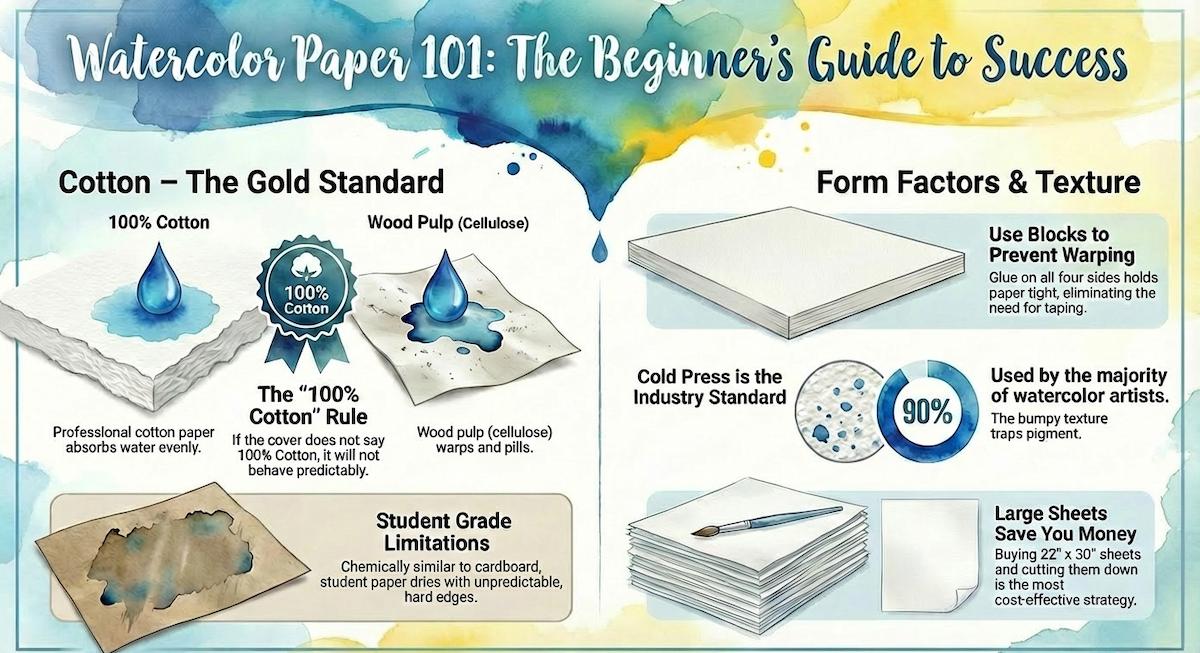
The Physics: Student paper is typically made of wood pulp (cellulose). It is chemically similar to cardboard. When you get it wet, it warps, pills up, and dries with hard edges that look uneven.
The Reality: Professional paper is 100% cotton. Cotton absorbs water evenly, allows you to "lift" (erase) mistakes, and lets colors blend smoothly.
The Rule: If the cover does not say "100% Cotton," do not expect it to behave like the tutorials you watch on YouTube.
How the paper is packaged changes how you paint.
1. Pads (Wire-bound or top-glued)
What they are: Standard sketchbook style.
The problem: The paper is loose. When you paint a wet wash, the paper will buckle.
The fix: You must tear the sheet out and tape it down to a board before painting.
Verdict: Good for practice and sketches.
2. Blocks
What they are: A stack of paper where all four sides are glued together with strong adhesive. It feels like a solid brick.
The advantage: You paint directly on the top sheet while it is glued to the block. The glue holds the paper tight like a drum, preventing it from warping while wet.
How to use it: Paint your masterpiece. Let it dry completely. Then, find the tiny gap in the glue (usually at the top of bottom center), insert a palette knife, and slice the sheet off to reveal the fresh one underneath.
Verdict: The best format for beginners. No taping required.
3. Sheets
What they are: Large single sheets (usually 22" x 30") sold in flat drawers at art stores.
The advantage: It is roughly 50% cheaper per square inch than pads or blocks.
The strategy: You can buy big sheets and cut them down into smaller pieces.
Verdict: Buy this if you have a guillotine cutter and want to save money long-term.
Watercolor paper typically comes in three finishes. You must choose the right one for your style.
1. Cold Press
Texture: Bumpy. It looks like traditional watercolor paper.
Why use it: The bumps trap the water and pigment, allowing for easy control and nice gradients. It is forgiving.
Verdict: Start here. 90% of artists use cold press.
2. Hot Press
Texture: Smooth.
Why use it: For fine detail, botanical illustration, or scanning.
The warning: It's slippery. The water puddles on top because there are no bumps to hold it. It is difficult for beginners to control.
3. Rough
Texture: Deep pits and valleys.
Why use it: For loose landscapes and "granulating" paints. The pigment settles into the deep holes, creating instant texture.
Level 1: The practice grade (wood pulp)
Canson XL Watercolor (Blue Pad): The most common student paper. It is durable but prone to "backruns" (blooms). Good for learning brush control, bad for finished art.
Strathmore 300 Series (Yellow): Decent, but wood pulp. Avoid if possible.
Level 2: The hybrid grade
Strathmore 400 Series (Brown): High-grade wood pulp. Better than Canson XL, but still not cotton.
Fabriano Studio (25% Cotton): A blend. It behaves slightly better than pure wood pulp but is still cheap.
Level 3: The professional grade (100% cotton)
Arches (The Gold Standard): Made in France. It smells like money. It can take a beating—you can scrub it, scratch it, and drown it, and it won't fall apart. If you want your painting to look professional, use this.
Fabriano Artistico: The Italian rival to Arches. Slightly whiter and smoother.
Baohong Academy: The budget cotton paper. Made in China. It is 100% cotton but costs half the price of Arches. Excellent value.
The absolute best start:
Try an Arches Cold Press Watercolor Block (7x10 inch).
Why: It eliminates the frustration of warping paper. It guarantees that if your painting looks bad, it's not the materials.
The budget cotton hack:
Try a pad of Bee Paper 100% cotton or Baohong Academy.
Why: You get the physics of cotton (smooth blends) without the Arches price tag.
What to Avoid:
Strathmore 200 Series or generic store brand watercolor pads. They are often just thin cardstock that will ruin your experience.